Filter Results
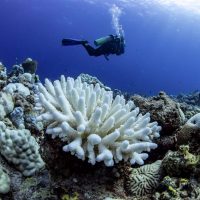
Coral bleaching is a significant problem for the world’s ocean ecosystems: When coral becomes bleached, it loses the algae that live inside it, turning it white. Corals can survive a bleaching event, but while they are bleached they are at higher risk for disease and death. Now an international consortium of scientists, including SAFS’ coral researcher Jacqueline Padilla-Gamiño, has created the first-ever common framework for increasing comparability of research findings on coral bleaching.
Read more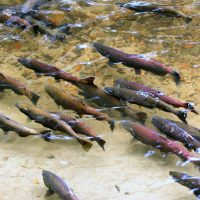
A new University of Washington study has found that Chinook salmon seem to use collective navigation and interact socially to help each other find fish ladders at dams.
Read more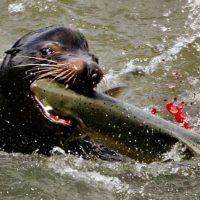
A new University of Washington and NOAA Fisheries study found that sea lions have the largest negative effect on early-arriving endangered Chinook salmon in the lower Columbia River. The results of this study will publish Oct. 18 in the Journal of Applied Ecology.
Read more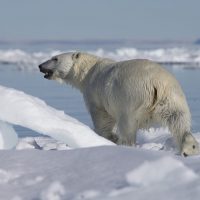
The small subpopulation of polar bears in Kane Basin were doing better, on average, in recent years than in the 1990s. The bears are experiencing short-term benefits from thinning and shrinking multiyear sea ice that allows more sunlight to reach the ocean surface, which makes the system more ecologically productive.
Read more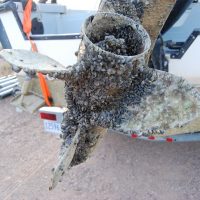
A new University of Washington study uses passive data from a fishing technology company to model the movement of anglers and predict where aquatic invasive species may be spreading.
Read more
Last quarter we explored SAFS’ vast research network throughout the world’s arctic, subarctic, and tropical regions. We now bring the focus back to Washington State and the fascinating science coming from our own backyard. Delve into some research highlights from our faculty, staff, and students with an interactive map taking you on a virtual tour all around our state.
Read more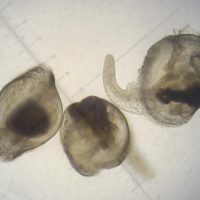
Pacific geoducks, among the largest burrowing clams in the world, are native to the Pacific Northwest. Commercially grown only since 1995, farmed geoducks now generate over $20 million in annual sales in Washington State and are among the most valuable farmed shellfish on a per-acre basis. However, hatcheries can be a critical production bottleneck.
Read more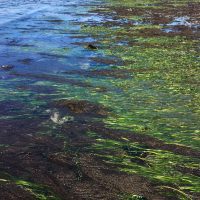
In the Pacific Northwest, eelgrass serves an important function in the ecosystem by binding sediments, storing carbon, and providing essential habitat for Pacific herring, juvenile salmon, and many other species. Concerningly, eelgrass populations are susceptible to human impacts related to water quality changes or direct disturbance. Eelgrass mitigation and restoration strategies often result in plants being transplanted to new locations where eelgrass may already be present. However, these efforts often lack information on the genetic population structure in an ever-changing environment. A team of interdisciplinary researchers at the University of Washington is developing baseline data for native eelgrass to make the first comprehensive geographic map of state eelgrass population structure and describe the relationship between eelgrass population structure, phenotypic diversity, and local adaptation and resistance to environmental stressors.
Read more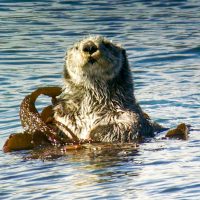
Learn how SAFS PhD student Jessie Hale examines patterns in sea otter feeding over time and space along the Washington coast.
Read more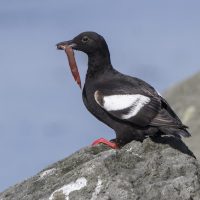
For nearly two decades, volunteers on Whidbey Island have been monitoring a curious little seabird—the pigeon guillemot, small in size, black with white patches on the wings and a fire-engine-red mouth and feet. Using binoculars, they observe and record the comings and goings of the island’s resident seabirds along the seaside cliffs.
Pigeon guillemots have been identified as a Puget Sound indicator species due to their abundance throughout the region, but what they might indicate is not yet clear.