Filter Results
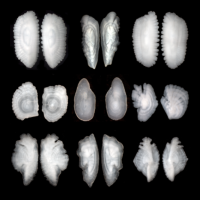
NOAA Fisheries recently featured the University of Washington’s 2.5-million-pair otolith archive, housed in the UW Fish Collection through a longstanding partnership involving the Burke Museum and the School of Aquatic and Fishery Sciences (SAFS). The story highlights the collection’s role in fisheries research and features Katherine Maslenikov, Ichthyology Collections Manager, who discusses the value of the archive for documenting fish populations and changes in ocean conditions over time.
Read more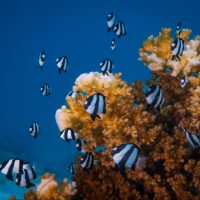
UW researchers are heading to the Maldives to study how fish communicate and respond to threats on coral reefs. The fieldwork includes our own SAFS research scientist Bob Oxborrow and will explore how fish behavior is influenced by the structure and health of their reef environment.
Read more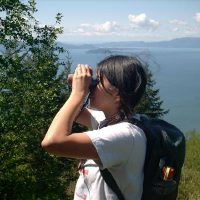
Sarah Tanja (M.S. 2026) ) and Celeste Valdivia (M.S. 2026; pictured above) were named 2026 Washington Sea Grant Hershman Fellows. The Washington Sea Grant Hershman Fellowship offers a unique educational opportunity to individuals engaged in studies pertaining to ocean and coastal policy issues.
Both Tanja and Valdivia will spend their fellowships at the University of Washington – Tacoma’s Puget Sound Institute.
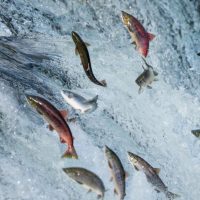
Dr. Thomas Quinn, Emeritus Professor at SAFS, offers insight into the remarkable annual migrations of Pacific Salmon, emphasizing that there is no single “salmon run,” but a series of species-specific migrations spanning the Pacific Northwest and Alaska.
Read more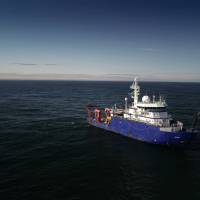
Visitors to the Anchorage Museum can explore Arctic marine science through a new exhibition featuring SAFS Professor and CICOES Director John Horne, whose work demonstrates how acoustic technology helps scientists observe life beneath the ocean surface.
Read more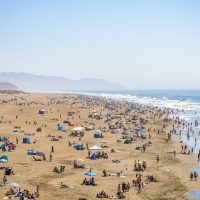
A new study co-authored by SAFS Professor Corey Garza highlights how structural barriers limit access to California’s coast and outlines pathways toward more equitable coastal management.
Read more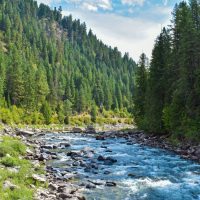
As the Trump administration moves to repeal the Roadless Rule, Dr. Julian Olden, the study’s lead author and Professor of the School of Aquatic and Fishery Sciences at University of Washington, said “it is difficult to overstate the importance of roadless areas for people and nature,” warning that weakening the rule could threaten both clean water and outdoor recreation.
Read moreAre you passionate about climate change solutions and science communication? Join a local research project studying public perceptions of ocean alkalinity enhancement (OAE), an emerging marine carbon dioxide removal technology being piloted right here in Washington State.
What You’ll Do
As a volunteer research assistant, you will help conduct visitor-intercept surveys at the Feiro Marine Life Center in Port Angeles Harbor, engage with the public about Project Macoma and ocean-based climate solutions, and answer guest questions about OAE and the local research being conducted.

We are nearing the end of the academic year, a time that naturally leads us to reflect the past year, and to look ahead to the next. Doing so fills with deep pride and admiration for SAFS, as our faculty, staff, and students have achieved so much despite numerous challenges. They continue to make important scientific breakthroughs on so many topics: unraveling equity in seafood trade, decoding whale vocalization, identifying threats of climate change to kelps and steelhead, documenting gaps in river conservation and much more.
Read more
Connor Whalen received the College of the Environment’s Exceptional Mentoring of Undergraduates award. This award, given annually to faculty, students and staff throughout the college, recognizes individuals for their efforts to develop undergraduate student research and the intellectual vibrancy of the College of the Environment.
Connor is a parasitologist, currently pursuing a M.S. in SAFS.
Connor’s nomination was noteworthy in that it was led by a large group of undergraduate students who have had the opportunity to work with him.