Filter Results
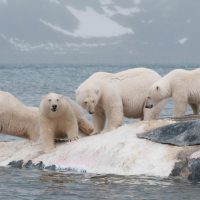
With 2019 on pace as one of the warmest years on record, a new international study reveals how rapidly the Arctic is warming and examines global consequences of continued polar warming.
Read more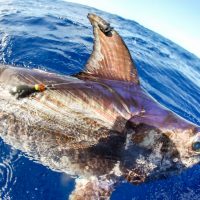
Researchers from the University of Washington are using high-tech tags to record the movements of swordfish — big, deep-water, migratory, open-ocean fish that are poorly studied — and get a window into the ocean depths they inhabit.
Read more
A team led by the University of Washington and Stanford University has discovered clues in the environment that help identify transmission hotspots for schistosomiasis, a parasitic disease that is second only to malaria in its global health impact. The research, publishing the week of Oct. 28 in the Proceedings of the National Academy of Sciences, uses rigorous field sampling and aerial images to precisely map communities that are at greatest risk for schistosomiasis.
Read more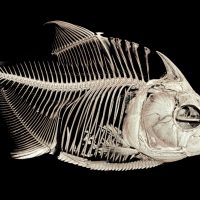
With the help of new technologies, a team led by the University of Washington has confirmed that piranhas — and their plant-eating cousins, pacus — do in fact lose and regrow all the teeth on one side of their face multiple times throughout their lives. How they do it may help explain why the fish go to such efforts to replace their teeth.
Read more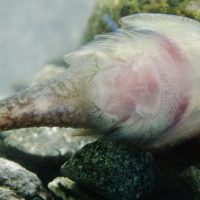
A University of Washington team inspired by the clingfish’s suction power set out to develop an artificial suction cup that borrows from nature’s design. Their prototype, described in a paper published Sept. 9 in the journal Philosophical Transactions of the Royal Society B, actually performed better than the clingfish.
Read more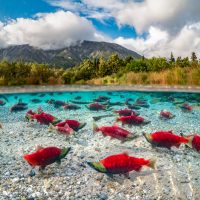
It’s hard to think small in Alaska. The largest of the United States is home to North America’s highest mountain range. It’s a place where undammed rivers run more than 1000 kilometers, glaciers collapse into the ocean, and polar bears roam. Daniel Schindler, however, is here hunting for something the size of a grain of rice.
Read more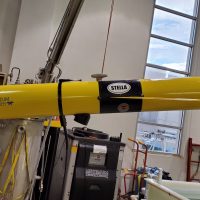
A multi-institution team consisting of the University of Washington School of Aquatic and Fishery Sciences (UW SAFS) Professor John Horne will deploy experimental technology next week to explore the deep scattering layers of the ocean. In addition to Horne, the UW team includes Ross Hytnen Jr. and summer intern Raymond Surya (a JISAO intern from the University of Michigan). Horne’s lab at SAFS uses active acoustic technologies to count and characterize aquatic organism distributions and dynamics throughout the world.
Read more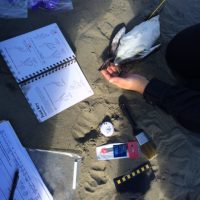
One of the most established hands-on, outdoor citizen science projects is the University of Washington-based Coastal Observation and Seabird Survey Team, COASST, which trains beachgoers along the West Coast, from California to Alaska, to monitor their local beach for dead birds. With about 4,500 participants in its 21-year history and roughly 800 active participants today, COASST’s long-term success is now the subject of scientific study in its own right. What makes people join citizen science projects, and what motivates people to stick with them over years?
Read more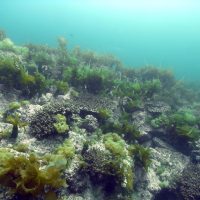
Coral reefs are retreating from equatorial waters and establishing new reefs in more temperate regions, according to new research published July 4 in the journal Marine Ecology Progress Series. The researchers found that the number of young corals on tropical reefs has declined by 85% — and doubled on subtropical reefs — during the last four decades.
Read more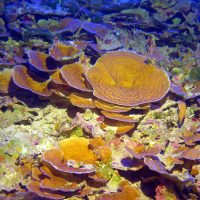
Just beyond where conventional scuba divers can go is an area of the ocean that still is largely unexplored. In waters this deep — about 100 to at least 500 feet below the surface — little to no light breaks through.
Read more