Filter Results
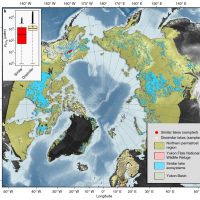
The dry northern reaches of Earth contain nearly half of all of the carbon originating in living matter, mostly stored in the frozen soils of the permafrost. It has been long thought that warming in the Arctic will result in this carbon being released from the soil and activated again, through the many lakes that are prominent features of the Arctic.
Read more
In 1906 while attending a livestock fair in Plymouth England, Sir Francis Galton witnessed an interesting contest where locals were trying to guess the correct weight of a slaughtered and dressed ox (think jellybeans in a jar, but for butchers). He examined all 800 guesses and calculated the median calling it the vox populi, or “voice of the people,” reasoning that this would cancel out outliers on either side of the true answer. Astonishingly, the median guess was extremely close–within .8%–of the weight measured by the judges and closer than any individual guess. “This started the idea of the wisdom of crowds, where if you have a whole bunch of independent guesses you can average them, cast off the errant guess on either side and hone in on the right answer,” said Dr. Andrew Berdahl one of the University of Washington School of Aquatic and Fishery Sciences’ newest faculty members.
Read more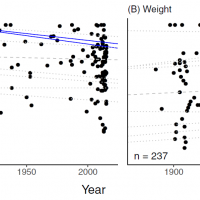
Shifting baselines is the concept that each human generation thinks “normal” conditions are those when they were growing up, and therefore only takes into account declines during their lifetime, instead of over multiple generations. A new paper now examines newspaper headlines over time to see whether declining fish size is detectable in fish described as superlatively enormous (e.g. “giant”, “huge”, or “monster”), finding declines in reports of lengths.
Read more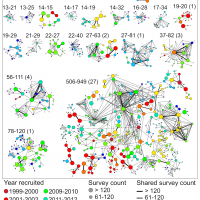
Citizen science, where the nonexpert public joins in freely to produce useful science, has grown to more than 2100 projects on the SciStarter website alone. These projects range from online identification of astronomical objects, to gaming-like projects predicting how proteins will fold (Foldit), to seasonal bird counts. One long-running project is COASST (Coastal Observation and Seabird Survey Team) where members of the public conduct monthly surveys of beach areas from California to Alaska looking for bird carcasses.
Read moreIt has long been established, indeed it is almost axiomatic, that annual variability in births of new fish (“recruitment”) is the most important reason why the total mass of fish populations varies from year to year. The rate of which individual fish grow (“body growth”) is also known to vary from year to year, but is generally considered to be fairly unimportant in explaining population variability.
Read moreScientists trained in ecology and physiology are increasingly able to complement their work with the burgeoning field of “functional genomics”, i.e. the study of which parts of DNA (the “genome”) are actually expressed and used to make proteins under different conditions. A new guide is now provided for those from non-genetic fields to harness the power of fast computers and rapid technology in sequencing the letters in DNA, so that they can infer how animals respond to the environment.
Read moreReef fish species from waters deeper than 130 m are difficult to collect manually, because they are too deep for SCUBA divers. But now manned submersibles equipped with underwater vacuums are able to suck up new specimens with surprising alacrity. Among the specimens slurped up by one such submersible is brand new blue and gold species of basslet: the blue-backed basslet (Lipogramma adabeli), with distinct blue coloration, genetics, and habitat use distinguishing it from other similar species.
Read more
The Columbia River used to host returns of nearly 9 million salmon every year, led by the largest returns in the world of Chinook salmon (4.4 million fish). But construction of multiple large dams on various tributaries and the Columbia River itself, eliminated salmon from vast tracts of rivers above impassable dams, and also had a serious effect on salmon survival in the remaining areas.
Read more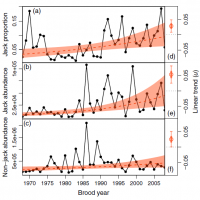
Male Pacific salmon usually compete aggressively with each other to gain access to spawning females, and are most successful when they are old and large. But a few males come back from the ocean early and small, and with less noticeable male traits. These small males are called “jacks” and cannot win battles of aggression but instead compete by sneaking into the spawning arena and fertilizing eggs on the sly.
Read moreGenetic engineering is widely used in plants and animals to promote rapid growth and create resistance to common diseases. One genetic modification that has achieved prominence in fish is the insertion of growth hormone transgenes, which produce dramatically larger sizes and rapid growth rates. However, there is concern that escaped genetically modified fish might breed with their wild counterparts, passing on the genetic modification and changing the wild population.
Read more