Filter Results
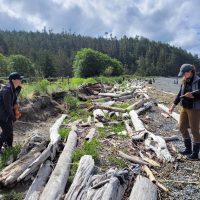
Jason Toft from the UW Wetland Ecosystem Team has been monitoring shoreline armor restoration in Puget Sound for over a decade at sites where artificial armor on beaches has been removed to facilitate the restoration of intertidal areas.
Shoreline armor, also known as seawalls and bulkheads, occurs on over 25% of Puget Sound’s shorelines and was historically installed along homes and infrastructure to address erosion risk.
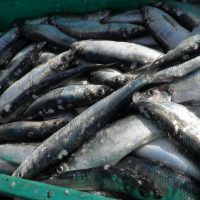
A new study produced by The Nature Conservancy (TNC) and the University of Washington (UW), with the lead researcher from SAFS, provides the first-ever nationwide assessment of non-federally managed fisheries in the United States.
Read more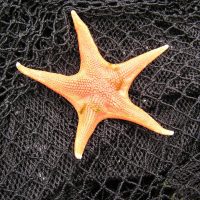
Since 1991, students and faculty at UW’s School of Aquatic and Fishery Sciences have conducted bottom trawl surveys in Port Madison through the School’s Fisheries Ecology course, creating an experiential learning opportunity for students and collecting valuable long-term data on physical and ecological change at a subtidal site in Puget Sound. Fortuitously, this long-term sampling gave students the data needed to investigate an unprecedented mass mortality event.
Read more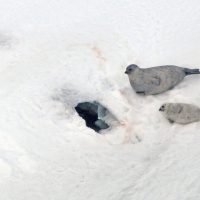
In the Arctic, where temperatures are rising at nearly four times the global average, a collaborative effort, combining Indigenous Knowledge with multidisciplinary science has been used to investigate the denning habitat selection of Alaska’s ringed seals.
During the Ikaaġvik Sikukun (Iñupiaq for “Ice Bridges”) project, researchers from the University of Washington School of Aquatic and Fishery Sciences (SAFS), Lamont-Doherty Earth Observatory of Columbia University, University of Alaska Fairbanks, the Native Village of Kotzebue, NOAA, and Farthest North Films collaborated with an Elder Advisory Council of Iñupiaq Qikiqtaġruŋmiut Elders with extensive personal history of subsistence hunting and experience on sea ice.
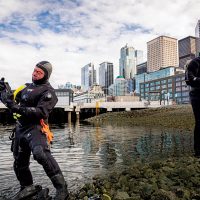
Along the seawall, which was designed with the help of UW scientists and engineers and serves as the foundation for the city’s new waterfront, the researchers count herring, shiner perch, sand lance, a growing host of invertebrates and, most importantly, salmon. All kinds of salmon.
This is just one place where the UW’s expertise touches on Seattle’s new central waterfront project, an $835 million public-private effort to reconnect the city’s downtown with Puget Sound.
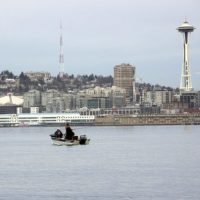
Few people would consider launching a boat into Seattle’s Elliott Bay on a winter morning. It’s cold, dark, and more often than not, wet. But the steadfast members of Seattle’s Tengu Club, a Japanese American fishing club that held its first annual salmon derby in 1946, can reliably be found doing just that.
When he first read about the Tengu Derby in the Seattle Times over a decade ago, UW School of Aquatic and Fishery Sciences (SAFS) Professor Thomas Quinn’s interest was piqued.
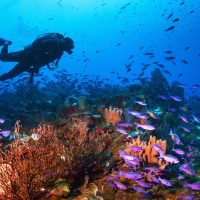
Coral reefs can adapt to climate change if given the chance to evolve, according to a study led by Coral Reef Alliance, Rutgers University, the University of Washington and other institutions.
The recent study, published in the journal Nature Ecology and Evolution, finds that coral reefs can evolve and adapt to the effects of climate change—but only if we protect a sufficient diversity of coral reefs, particularly when it comes to temperatures.
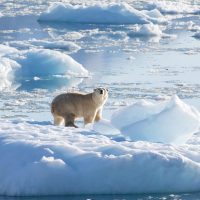
A new population of polar bears documented on the southeast coast of Greenland use glacier ice to survive despite limited access to sea ice. This small, genetically distinct group of polar bears could be important to the future of the species in a warming world.
Read more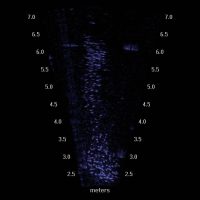
By mounting a specialized mobile sonar called a DIDSON (Dual-frequency IDentification SONar) under a kayak, UW research scientist Kerry Accola is able to count the juvenile salmon along the shoreline from the water’s surface. The sonar is capable of capturing high fidelity images during the day and also the night, when normal visibility is greatly reduced.
Read more
Graduate student Jessie Hale released a paper rethinking the status, trends, and equilibrium abundance estimates of Washington State’s sea otter population and Ruth Drinkwater’s (BS 2021) capstone project, “Estimating proportions of identical twins and twin survival rates in cetaceans using fetal data,” was published in Marine Mammal Science.
Read more