Filter Results
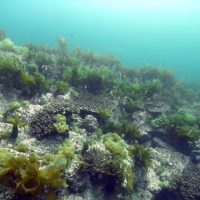
Coral reefs are retreating from equatorial waters and establishing new reefs in more temperate regions, according to new research published July 4 in the journal Marine Ecology Progress Series. The researchers found that the number of young corals on tropical reefs has declined by 85% — and doubled on subtropical reefs — during the last four decades.
Read more
Each year, our students, faculty and staff win regional, national, and international awards. Please join us in congratulating the latest group of award winners.
Read more
The six months since we published the previous issue of the newsletter have been exhilarating, exhausting, and just plain amazing as I hope you will see from these articles.
Read more
Mark Scheuerell is the newest member of the SAFS faculty. He joins SAFS as the Assistant Unit Leader, Fisheries, in the Washington Cooperative Fish and Wildlife Research Unit (WACFWRU), and an Associate Professor.
Read more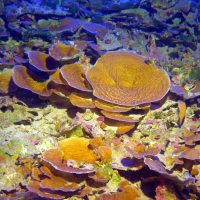
Just beyond where conventional scuba divers can go is an area of the ocean that still is largely unexplored. In waters this deep — about 100 to at least 500 feet below the surface — little to no light breaks through.
Read more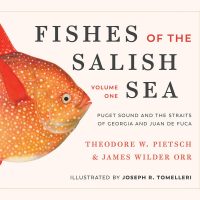
“Art and science collide magnificently in this monumental three-volume celebration of the 260 species of fishes that infuse the inland marine waters of Washington State and British Columbia, with hidden beauty, remarkable diversity and intriguing ways of living. This long-awaited work is a must-have not just for serious scientists and devotees of exquisite natural history artistry, but for any and all who find joy in exploring the wonders of nature.”―Sylvia Earle, National Geographic Explorer in Residence, Founder, Mission Blue
Read more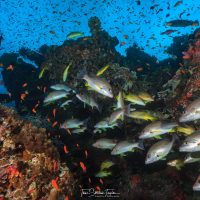
Coral reefs typically evoke clear, turquoise waters and a staggering number of colorful fishes. But what supports such an abundance of life?
Read more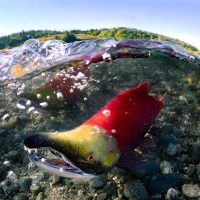
Chemical signatures imprinted on tiny stones that form inside the ears of fish show that two of Alaska’s most productive salmon populations, and the fisheries they support, depend on the entire watershed.
Read more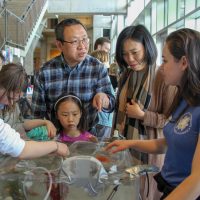
When: May 4th, 2019 from 1-4 pm
Locations: Fishery Sciences Building (FSH), 1122 Boat Street, Seattle, WA 98105;
Ocean Sciences Building (OSB), 1492 NE Boat St, Seattle, WA 98105
Cost: FREE!
Come join us for a free and family-friendly afternoon of hands-on learning at Our Watery World, the second annual aquatic science open house at the UW to celebrate science and research that relates to water.
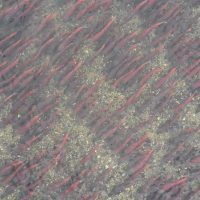
In 1906 while attending a livestock fair in Plymouth England, Sir Francis Galton witnessed an interesting contest where locals were trying to guess the correct weight of a slaughtered and dressed ox (think jellybeans in a jar, but for butchers). He examined all 800 guesses and calculated the median calling it the vox populi, or “voice of the people,” reasoning that this would cancel out outliers on either side of the true answer. Astonishingly, the median guess was extremely close–within .8%–of the weight measured by the judges and closer than any individual guess. “This started the idea of the wisdom of crowds, where if you have a whole bunch of independent guesses you can average them, cast off the errant guess on either side and hone in on the right answer,” said Dr. Andrew Berdahl one of the University of Washington School of Aquatic and Fishery Sciences’ newest faculty members.
Read more