Filter Results
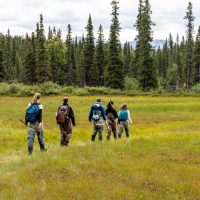
Students fly 1,777 miles northwest of Seattle and spend a month with the Alaska Salmon Program at their field stations on the banks of Lake Aleknagik and Lake Nerka. Part of the larger Wood River system, these lakes, their creeks, and the surrounding wilderness serve as a “living laboratory” where students are immersed in one of the most valuable salmon fisheries on the planet.
Read moreIn a world’s first, a mating pair of anglerfish is observed in the wild, evoking awe in SAFS professor Ted Pietsch, who comments in UW Today on the video footage by researchers Kirsten and Joachim Jakobsen aboard a submersible run by the Rebikoff-Nigeler Foundation. Only 14 females (and no males) of this species have ever been recorded, all collected in jars and none observed alive in the ocean.
Read moreBy Ben Miller, SAFS student
When you first arrive at the community of Kampong Phluk, your neck cranes up bamboo stilts to meet the chatter of families in houses high above. From the top of what guidebooks call “bamboo skyscrapers,” locals gaze over the tops of submerged trees, a glittering, island Buddhist temple, and clusters of floating fishing villages in the distance.
SAFS Professor Chelsea Wood was awarded a Sloan Fellowship, awarded to early-career researchers in recognition of distinguished performance and a unique potential to make substantial contributions to their field. Prof. Wood is a prolific researcher who uses parasites and pathogens (both human and fish-based) to uncover fundamental ecological truths about the natural world. She will receive $65,000 to further her research initiatives, which includes using museum fish specimens as “parasite time capsules”, as reported in UW News.
Read moreThe recipient will be awarded with a 2-6 month collaborative visit to SAFS beginning in summer 2018, which covers travel, housing, research supplies and a modest stipend each month, for a total value of up to $29,000. The award honors the many lasting and excellent contributions of Prof Kenneth K. Chew to aquaculture.
Read moreSAFS faculty Jacqueline Padilla-Gamino and graduate student Jeremy Axworthy just returned from a trip to Hawaii where they performed coral bleaching experiments to understand the effects of stress from heating on coral feeding and reproduction. Their study aims to find biomarker molecules to identify corals that are most likely to recover and reproduce after a bleaching event, improving predictions of coral responses to bleaching events.
Read moreTo celebrate International Open Access Week, the University of Washington Libraries posted profiles and interviews with two SAFS faculty, Julia Parrish and Steven Roberts, about how they conduct their research openly. The interview with Julia Parrish focuses on her citizen science work, which involves trained members of the public identifying and pinpointing the locations of more than 10,000 dead birds on the Pacific coast each year, and making the data available openly as well as in scientific publications.
Read moreMarine Biology (FISH250) is the core class for the College of the Environment Marine Biology Minor, where students learn principles of oceanography, biology, physiology and reproduction of marine taxa. The course focuses on the adaptations organisms need to thrive in their marine environments. The class includes active student discussion, class polls, and the opportunity to experience and experiment with key concepts in the laboratory section and fun field trips to Friday Harbor, Alki Beach (night low tide), Ocean Shores and others.
Read moreA front page investigative CNN article outlines how the Environmental Protection Agency reversed a decision to protect the most valuable salmon fishery in the world, giving the go-ahead for the Pebble Mine, one hour after the head met with the CEO of the Pebble Mine partnership. SAFS professor Thomas Quinn comments in the report: “This is the jewel in the crown of America’s fisheries resources – these salmon.
Read moreCitizen scientists in a program run by Julia Parrish provided data about two mass die-offs of seabirds on the outer coast of Washington state, which is the largest mass death ever to be definitively ascribed to harmful algal blooms. The new report was authored by SAFS postdoc Timothy Jones, with other SAFS contributions from Julia Parrish, André Punt, and Jennifer Lang, as part of the Coastal Observation and Seabird Survey Team (COASST; a citizen science program at the University of Washington).
Read more