Filter Results
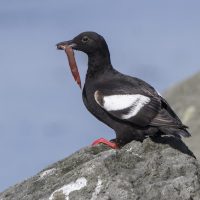
For nearly two decades, volunteers on Whidbey Island have been monitoring a curious little seabird—the pigeon guillemot, small in size, black with white patches on the wings and a fire-engine-red mouth and feet. Using binoculars, they observe and record the comings and goings of the island’s resident seabirds along the seaside cliffs.
Pigeon guillemots have been identified as a Puget Sound indicator species due to their abundance throughout the region, but what they might indicate is not yet clear.

The UW Center for Latino Health has recognized 32 UW Latinx faculty for scholarly achievements, including Jacqueline Padilla-Gamiño, assistant professor at the UW School of Aquatic and Fishery Sciences, who has been honored for the second year in a row. This annual event honors the scholarly achievements of Latina and Latino faculty across the three campuses of the University of Washington.
Read more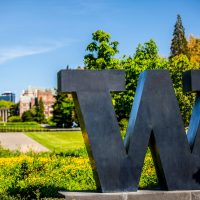
The recent events make us feel heartbroken, angry, and even more acutely aware that our pursuit of achieving our commitments and goals for an equitable and safe School is paramount. We will recommit ourselves to achieving these commitments and goals, and will continue down the path we have decided upon, no matter what.
Read more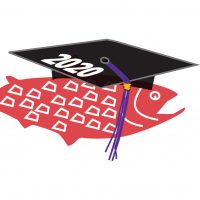
Congratulations to all of our graduates! View our graduation page to learn more about them and their accomplishments.
Read more
Three graduate students from the College of the Environment have been awarded the National Science Foundation (NSF) Graduate Research Fellowship, which recognizes and supports outstanding graduate students in science, technology, engineering and mathematics. This year’s awardees include Irita Aylward and Zoe Krauss from the School of Oceanography, and Helena McMonagle from the School of Aquatic and Fishery Sciences.
Read more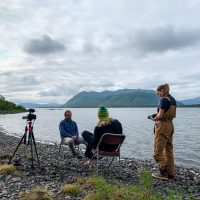
Last year, the UW Alaska Salmon Program partnered with Waterlust, an apparel and media company, to develop a line of salmon-inspired clothing. Waterlust’s clothing line, dubbed “advocated apparel,” aims to bring awareness to aquatic science and conservation-based causes by turning designs found in nature into fashion. The company has previously worked with other institutions and nonprofits to develop prints inspired by sea turtles, whale sharks, and spotted dolphins.
Read more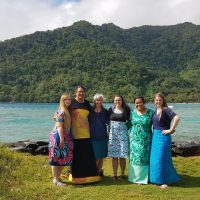
SAFS’ global network is one of its greatest strengths, providing nearly limitless opportunities for scientific and personal discovery. Explore some of our research highlights, spread across tropical and northern latitudes, through an interactive map. Deep dive into our new and exciting projects that provide students interdisciplinary study abroad experiences.
Read more
Each year, our students, faculty, and staff win regional, national, and international awards. Please join us in congratulating this year’s group of award winners!
Read more
In fall 2019, José Guzmán was appointed as a lecturer at SAFS, where he had been an instructor from 2015 to 2019. José has been recognized for his teaching excellence, receiving both the UW Distinguished Teaching Award and the College of the Environment Outstanding Teaching Award in 2019. A native of Spain, José earned his BS, MS, and PhD degrees in Marine Sciences at the University of Cádiz. Before coming to SAFS, José was a postdoctoral fellow at the Northwest Fisheries Science Center, NOAA Fisheries.
Read more
Camrin Braun (Cam), an oceanographer and fish ecologist focused on top predators, joined the SAFS faculty in fall 2019. Prior to coming to SAFS, Cam was a NASA-funded postdoctoral research scientist at the UW Applied Physics Laboratory and before that, a PhD student in Simon Thorrold’s lab at the Woods Hole Oceanographic Institution and the Massachusetts Institute of Technology. Cam’s research leverages computational and field-based approaches to unite biophysical interactions with the challenges of managing fisheries in a dynamic ocean.
Read more