Filter Results
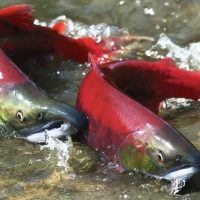
Most people wouldn’t be excited by a call offering a basement full of canned salmon dating back to the 1970s. But for researchers trying to establish baselines for what’s normal and what’s not when it comes to aquatic parasite populations, the archive of fishy tins, maintained by the Seattle-area Seafood Products Association, was a valuable resource. Natalie Mastick, a PhD candidate in the University of Washington’s School of Aquatic and Fishery Sciences, joins guest host Roxanne Khamsi to explain the study.
Read more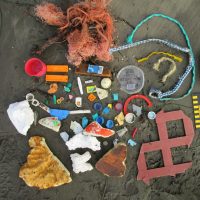
Citizen scientists recorded trash on Pacific Northwest beaches, from southern Oregon to Anacortes, Washington, to contribute to the growing study of marine trash. A study by the University of Washington analyzed 843 beach surveys and found that certain beaches, and certain areas of a single beach, are “sticky zones” that accumulate litter.
Read more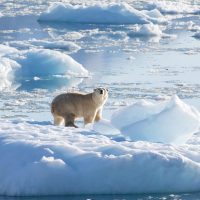
A new population of polar bears documented on the southeast coast of Greenland use glacier ice to survive despite limited access to sea ice. This small, genetically distinct group of polar bears could be important to the future of the species in a warming world.
Read more
Join us for the 2022 UW Aquatic Sciences Open House hosted by SEAS this Saturday (May 21st) from 10 AM to 4 PM in FSH. We hope to see you all there!
Read more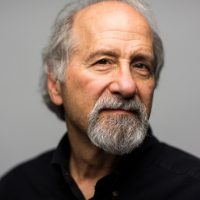
The Founders’ Medal is awarded to persons who have made a substantial contribution to the study of the history or bibliography of natural history through a sustained record of high-quality publications, and a sustained contribution to dissemination of the history of natural history through practice or curation.
Read more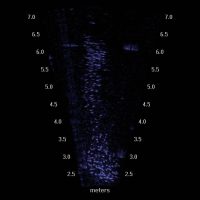
By mounting a specialized mobile sonar called a DIDSON (Dual-frequency IDentification SONar) under a kayak, UW research scientist Kerry Accola is able to count the juvenile salmon along the shoreline from the water’s surface. The sonar is capable of capturing high fidelity images during the day and also the night, when normal visibility is greatly reduced.
Read more
Congratulations to José Guzman and Sarah Converse who were recognized by the UW College of the Environment for Exceptional Mentoring of Undergraduates and Outstanding Diversity Commitment, respectively
Read more
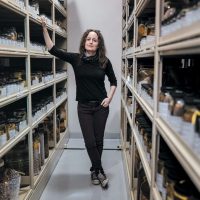
Parasites play an outsize role in balancing ecosystems, and some species may be in danger. Read the article from Scientific American featuring SAFS’ Chelsea Wood.
Read more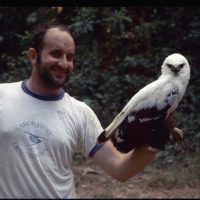
SAFS Emeritus Professor Jim Karr began a long-term bird study in Panama 55 years ago while he was a Ph.D. student and later as a professor of ecology at the University of Illinois. He explains that the core of the current study design and its methodology were initiated in 1977. The study continues to this day under its third generation of leadership.
Read more