Filter Results
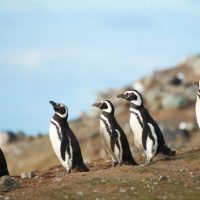
Forage fish, like anchovies and sardines, are a dietary staple for seabirds. Around the globe, seabirds have adapted in order to cope with natural changes in the availability of these prey fish. However, increased fishing pressure on these forage species is thought to be altering this predator-prey relationship in an adverse way for seabird populations. The natural ability of seabirds to cope with changes in prey abundance makes it difficult for researchers to determine if they are responding to natural processes or to human fishing practices.
Read more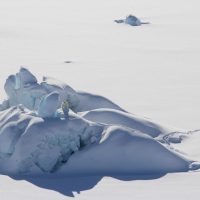
The region north of Greenland and the Canadian Arctic has been termed the Last Ice Area, where sea ice will remain the longest in summertime, providing a refuge for ice-dependent Arctic species. But conditions last summer show that parts of this region are already experiencing less summer ice due to climate change.
Read more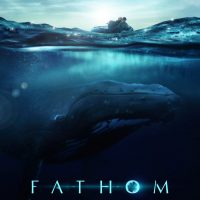
PhD candidate Natalie Mastick Jensen will be featured in an upcoming documentary premiering on June 25th on Apple TV+. As a research assistant, Natalie worked with Dr. Michelle Fournet for two weeks in southeast Alaska on a humpback whale playback study. The team worked to determine the social function of a certain non-song vocalization called the whup call.
Read more
A new paper by Katherine Pearson Maslenikov published in Ichthyology and Herpetology outlines the history of the UW Fish Collection and its long partnership with NOAA and other state and federal agencies.
Read more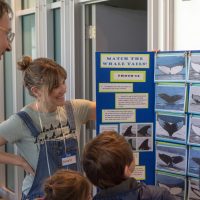
Join the SAFS community for the SEAS 2021 Open House, May 19–22! This year’s free virtual Open House offers four days of family-friendly activities to safely celebrate science and research that relates to water.
Read more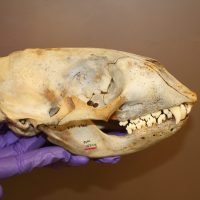
The adage “you are what you eat” generally turns out to be true. Foods we ingest are broken down into amino acids and absorbed into our bodies, leaving trace elements in our bones. In turn, these amino acids can be traced back to their source like a biological receipt, revealing information about the environment. Using this knowledge, researchers are conducting isotope analysis of amino acids in harbor seal skulls to determine the composition of historical marine food webs.
Read more
Professor Chris Anderson was featured on NPR’s Planet Money podcast – a show that aims to take complex economic issues and make them approachable for all audiences. On the show, Chris answers a listener’s question on the environmental footprint of shipping tuna across the ocean.
Listen to the podcast
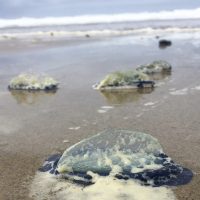
Thanks to 20 years of observations from thousands of citizen scientists, University of Washington researchers have discovered distinct patterns in the mass strandings of by-the-wind sailor jellies. Specifically, large strandings happened simultaneously from the northwest tip of Washington south to the Mendocino coast in California, and in years when winters were warmer than usual.
Read more
The Ecological Society of America (ESA) is honored to announce the Katherine S. McCarter Graduate Student Policy Award (GSPA) 2021 cohort. This award provides graduate students with the opportunity to receive policy and communication training before they meet lawmakers. ESA selected 23 students to receive the award including Julia L. Indivero from the University of Washington School of Aquatic and Fishery Sciences.
Read more
Herring that spawn at different times of the year are genetically distinct from one another, according to a new paper published Feb 24th in the Proceedings of the Royal Society B. The study, led by Eleni Petrou and Lorenz Hauser from the University of Washington School of Aquatic and Fishery Sciences, shows that populations of Pacific herring along the US west coast are genetically structured based on when they spawn and secondarily, where they spawn.
Read more