Filter Results
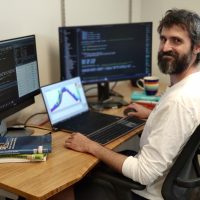
In a post-doc focused on modeling climate change effects in the Gulf of Alaska (GOA), Alberto Rovellini is part of the Punt Lab at SAFS. Beginning in 2020, Alberto’s work is on this area of Alaska which is facing big implications as a result of climate change, from negative economic implications for important fisheries to adverse ecological impacts on plankton, fish, mammals, and seabirds.
Read more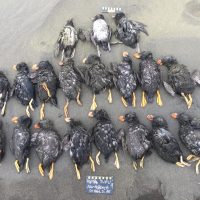
New research led by the University of Washington uses data collected by coastal residents along beaches from central California to Alaska to understand how seabirds have fared in recent decades. The paper, published July 6 in the journal Marine Ecology Progress Series, shows that persistent marine heat waves lead to massive seabird die-offs months later.
Read more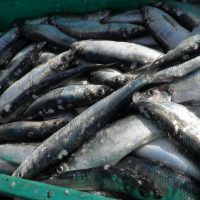
A new study produced by The Nature Conservancy (TNC) and the University of Washington (UW), with the lead researcher from SAFS, provides the first-ever nationwide assessment of non-federally managed fisheries in the United States.
Read more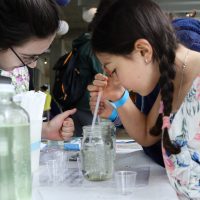
Another year, another fantastic day of bringing science to life at the UW Aquatic Sciences Open House. Featuring 30 booths, each with an interactive activity dedicated to specific research underway in the world of water, this year’s Open House welcomed more than 600 visitors.
Making aquatic science accessible to all is one of the driving forces behind the Open House. The event is hosted by the School of Aquatic and Fishery Sciences, which sits on the south campus of the University of Washington and just across from Portage Bay.
Read more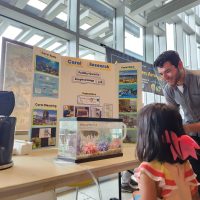
The UW Aquatic Sciences Open House was featured in a 2-minute segment on FOX 13 Seattle, showcasing the breadth of research and highlighting the importance of Open House events for accessibility and inspiring a new generation of scientists.
Read more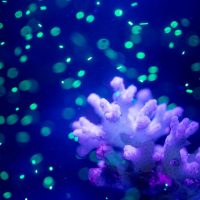
Tiny pieces of plastic in the ocean might seem innocuous on their own, but their growing presence is a frustrating issue facing marine ecosystems. The particles’ small size makes them difficult to clean up, and it also allows them to easily burrow into marine environments or even get ingested by ocean organisms.
Read more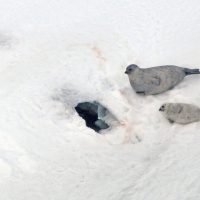
In the Arctic, where temperatures are rising at nearly four times the global average, a collaborative effort, combining Indigenous Knowledge with multidisciplinary science has been used to investigate the denning habitat selection of Alaska’s ringed seals.
During the Ikaaġvik Sikukun (Iñupiaq for “Ice Bridges”) project, researchers from the University of Washington School of Aquatic and Fishery Sciences (SAFS), Lamont-Doherty Earth Observatory of Columbia University, University of Alaska Fairbanks, the Native Village of Kotzebue, NOAA, and Farthest North Films collaborated with an Elder Advisory Council of Iñupiaq Qikiqtaġruŋmiut Elders with extensive personal history of subsistence hunting and experience on sea ice.
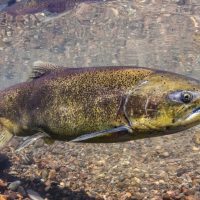
As part of the Climate Talk series by Radio Tacoma, Dr. Mark Scheuerell from SAFS joined to speak about PNW salmon populations and what they tell us about the state of our environment. Click the link and scroll down to listen to the episode.
Read more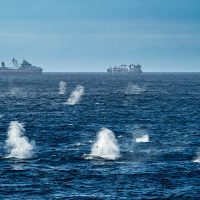
In a study led by Stanford University and Lindblad Expeditions, and co-authored by Trevor Branch from SAFS, scientists observed close to 1,000 fin whales foraging near Antarctica, while fishing vessels trawled for krill in their midst.
Read more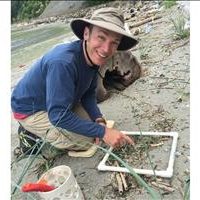
Read about his involvement in designing the replacement seawall along Seattle’s central waterfront and the key design features devised to make the environment as hospitable as possible for juvenile salmon, especially Chinook and Chum salmon, as they out-migrate from the river system to the ocean.
Read more