Filter Results
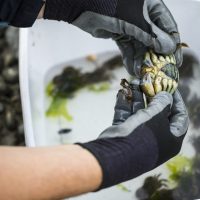
For almost a decade, the Washington Sea Grant Crab Team has been surveilling the advance of the invasive European green crab. In 2015, the team was formed to engage citizen scientists in a search for the first signs of an invasion into Puget Sound, with the first documented trap of a green crab taking place a year later in August 2016. They have now been found in more than 30 trapping sites. A new story in Salish Sea Currents features tracking efforts tracking efforts and research into the invasive crab.
Read more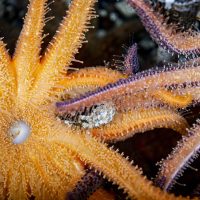
Until now, no one knew what caused the sea star wasting disease which wiped out populations along the West Coast starting in 2013. But an international research effort including scientists from the University of Washington has finally revealed the cause: a strain of the bacterium Vibrio pectenicida.
Read more
A new story in the Seattle Times shows just how alive the Seattle waterfront is, if you know where to look. From baby salmon to bull kelp, the renovations at the waterfront include a seawall where the public can look down at the fish-friendly seawall. The UW Wetland Ecosystem Team has been instrumental in this work, with continued monitoring of the site.
Read more
Jose Guzmán wanted to help bridge the gaps that undergraduates faced in participating in research, and that graduate students faced in mentoring. And so, the IBIS program was born.
Read more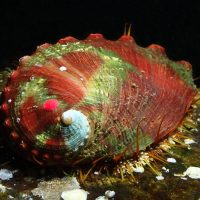
A new study, led by recently-graduated doctoral student Eileen Bates and principal investigator Jacqueline Padilla-Gamiño, and funded by Washington Sea Grant, found climate change stressors negatively impact pinto abalone during their larval stage.
Read more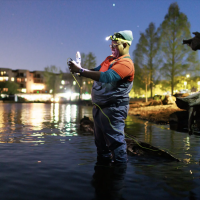
Wearing a bright orange and gray dry suit, Ashley Townes stepped into the murky water of Lake Washington under a yellow moon, at a time when most others are asleep. A recent Seattle Times story features Ashley’s work as a fish biologist and a member of a grassroots group of neighbors who have advocated and fundraised for years to restore Be’er Sheva Park, to restore the shoreline and salmon habitat.
Read more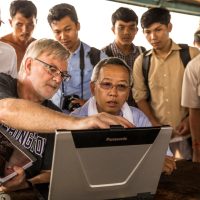
A new video by ICES explores a solar-powered acoustic monitoring system that tracks fish migrations and provides near-real-time data to support sustainable fishing, featuring John Horne.
Read more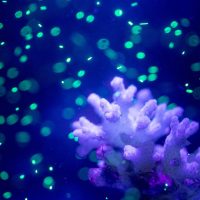
Microplastics are everywhere. From the clothes you wear to the food you eat, to even your toothbrush, microplastics are difficult to avoid. And these tiny pieces of plastic have big consequences for both humans and the wider environment. UW Daily speaks to Jacqueline Padilla-Gamiño about her research into microplastics and marine organisms such as corals and anemones.
Read more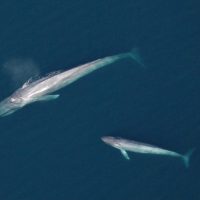
Only two blue whale births have ever been recorded in human history, an extraordinary mystery given they give birth every two to three years. Calves are also only rarely sighted—far less than would be expected from their pregnancy rates. Calves closely follow their moms and are sighted as mother-calf pairs, but why are so few detected? A new UW study by Trevor Branch proposes why. Its explanation hints at when and where the unseen births are happening and where blue whale calves spend their earliest months.
Read more
10 years ago, the UN declared 11 February as the International Day of Women and Girls in Science. On this 10th anniversary at the University of Washington, we’re celebrating our women in aquatic and marine science: women who are leaders in their fields, women who are aspiring to be the next generation of fisheries scientists and marine biologists, women who are uplifting and supporting other women in science.
Read more