Filter Results

New research led by SAFS doctoral student, Arial Brewer, documents the vocal repertoire of Cook Inlet beluga whales for the first time.
Read more
Recently featured in Hakai Magazine’s article “All The Fish We Cannot See”, SAFS PhD student Helena McMonagle is conducting a deep dive into a hidden cache of fish that might play an unexpected role in how the ocean sequesters carbon. We caught up with Helena to find out more about it.
Since starting this research in 2019, I’ve been using data collected at sea and in the lab, along with bioenergetic models, to estimate how much carbon these mesopelagic fish, such as lanternfish, transport from surface waters into the twilight zone.

UW researchers are developing a drone-based salmon survey method that the Sauk-Suiattle can use to manage resources.
Read more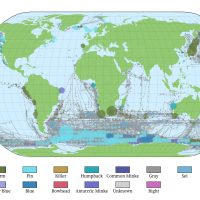
A team at UW, including Trevor Branch from SAFS and Zoe Rand from QERM, have created an online interactive map called WhaleVis, which lets whale researchers visualize the IWC’s data on global whale catches and whaling routes. From this, researchers can estimate the animals’ spatial distribution and the effort whalers put into hunts.
Read more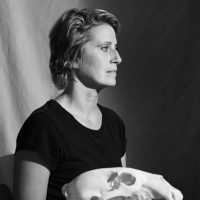
The Arctic is warming much faster than the rest of the planet. I study animals that are inextricably tied to the sea ice, which is disappearing. Narwhals spend most of their time in deep water, in and under dense ice. They need cold water. The other species I study is polar bears. Everything about being a polar bear is tied to the ice.
Read more
Historical ecology and data-limited fisheries stock assessment methods shed light on threatened Puget Sound Yelloweye Rockfish
By applying elements of historical ecology, fisheries science, and conservation biology in a highly collaborative research effort, researchers from the University of Washington School of Aquatic and Fishery Sciences (SAFS), NOAA Fisheries, and the Washington Department of Fish and Wildlife (WDFW) are delivering new insights into the status of Yelloweye Rockfish.
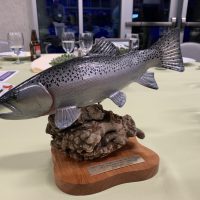
As part of the Trout Unlimited annual awards, SAFS Professor Tom Quinn has received the Jack Williams Award for Applied Conservation Science. Read about why Tom was selected for this award in the write-up below, reposted from Trout Unlimited.
Recently retired from full-time teaching and research at the University of Washington, Professor Tom Quinn deserves massive thanks for the huge body of research and writing on Pacific Rim fisheries and especially on salmon and trout of the Pacific Northwest and Alaska.
Read more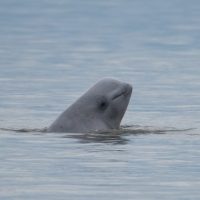
New study uses integrated population models to predict extinction risk for Cook Inlet beluga whales and lend insight into factors limiting the recovery of protected populations.
Sparse monitoring data and persistent knowledge gaps can hamper conservation efforts aimed at recovering depleted wildlife populations. In a new study, researchers from the UW School of Aquatic and Fishery Sciences (SAFS) set out to tackle this issue for federally endangered Cook Inlet beluga whales by developing an integrated population model that capitalizes on all available information to understand factors that may be affecting survival, reproduction, and population viability.
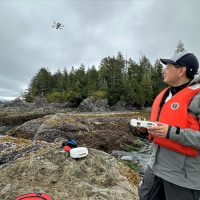
Welcoming the newest SAFS Professor and Associate Dean for Diversity, Equity and Inclusion for the College of the Environment, we spoke with Corey Garza. He shares his plans to enhance College diversity, what he’s most excited about by joining SAFS, and insight into his world of research using drones.
What plans do you have for Diversity, Equity and Inclusion (DEI) as Associate Dean?
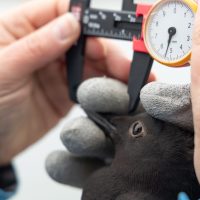
Nesting season on Protection Island is a busy time for SAFS Masters student, Liam Pendleton. Home to tens of thousands of pigeon guillemots and rhinoceros auklets, Liam travels to Protection Island in the Strait of Juan de Fuca every week from May to September to conduct research and monitoring of these seabirds.
Working in the Quantitative Conservation Lab, led by Sarah Converse, Liam is studying the link between breeding success, and marine environmental conditions.