Filter Results
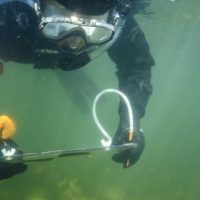
As part of the UW Wetland Ecosystem Team’s Seattle Seawall Fish Monitoring Program, an underwater video from 2022 has been released.
Documenting what lies beneath in Year 5 of the project in 2022, the video is compiled from snorkel and SCUBA surveys to monitor effectiveness of the Seattle seawall rebuild for improving habitat for juvenile salmon and other nearshore fishes.
For more information visit http://depts.washington.edu/wetlab/
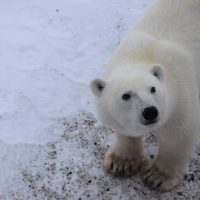
On International Polar Bear Day, the plight of these apex predators could not be more evident, as a result of a myriad of threats to their existence due to climate change.
As their name suggests, polar bears live in the Arctic polar regions of Canada, Greenland, Russia and Alaska. Kristin Laidre, a UW scientist at SAFS, shares that polar bears require ice for almost every aspect of their existence, including feeding, moving, breeding and in some places, maternity denning.
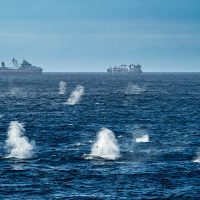
In a study led by Stanford University and Lindblad Expeditions, and co-authored by Trevor Branch from SAFS, scientists observed close to 1,000 fin whales foraging near Antarctica, while fishing vessels trawled for krill in their midst.
Read more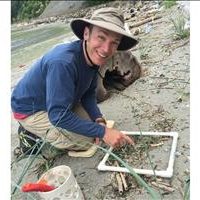
Read about his involvement in designing the replacement seawall along Seattle’s central waterfront and the key design features devised to make the environment as hospitable as possible for juvenile salmon, especially Chinook and Chum salmon, as they out-migrate from the river system to the ocean.
Read more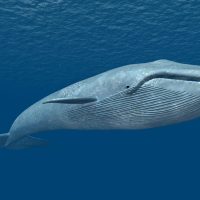
The biggest animals to have ever lived on our planet, blue whales are a charismatic species found across the world’s oceans.
Ranging in size from 79 ft in the Indian Ocean’s pygmy blue whale subspecies to more than 100 ft in Antarctic blue whales, these marine mammals were once hunted to near extinction.
In order to reconstruct past level of whales and discover if blue whale populations were recovering or not after the banning of commercial whaling in the 1980s, scientists have developed models that explain both old whaling catch records and modern-day counts.
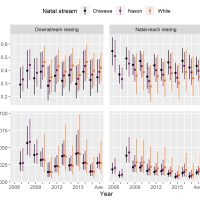
Differences in the life history pathways (LHPs) of juvenile animals are often associated with differences in demographic rates in later life stages. For migratory animals, different LHPs often result in animals from the same population occupying distinct habitats subjected to different environmental drivers.
Read more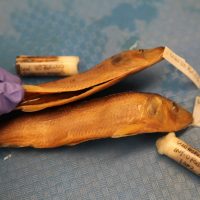
More than a century of preserved fish specimens offer a rare glimpse into long-term trends in parasite populations. New research from the University of Washington with lead author Chelesea Wood from SAFS, shows that fish parasites plummeted from 1880 to 2019, a 140-year stretch when Puget Sound — their habitat and the second largest estuary in the mainland U.S. — warmed significantly.
Read more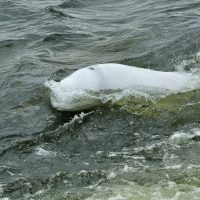
The beluga whale population in Alaska’s Cook Inlet, which connects Anchorage to the North Pacific Ocean, is listed as endangered and has declined by over 75% from about 1,300 whales in the late 1970’s to fewer than 300 today.
Understanding whether the decline is due to low birth or low survival rates, or a combination of the two, can give scientists clues about the external threats that are impacting the population.
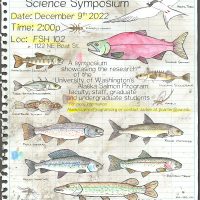
Taking place on Friday 9 December at 2pm, the agenda for the 2022 Alaska Salmon Program Annual Science Symposium has been announced. The event will be held in FSH 102, in the Fishery Sciences Building.
This symposium showcases the research of the UW School of Aquatic and Fishery Sciences’ Alaska Salmon Program undergraduate and graduate students, faculty, staff and visiting scientists.
Read more
With its unique position spanning marine and freshwater environments, the School of Aquatic and Fisheries Science (SAFS) attracts researchers, scientists, scholars and students from a wide sea of disciplines.
The first in a new series of SAFS Spotlight, we spoke with Sarah Converse, Associate Professor at SAFS and Unit Leader of the U.S. Geological Survey, Washington Cooperative Fish and Wildlife Research Unit.