Filter Results
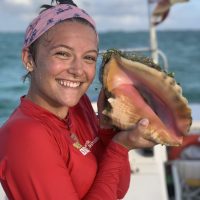
Last quarter we caught up with Delaney Lawson who was down on South Caicos as part of a study abroad experience with the School for Field Studies (SFS)
Read more
Take a deep dive into the ecology of marine top predators and the ocean ecosystems they rely on in FISH 497B
Read more
The University of Washington School of Aquatic and Fishery Sciences recently hosted the SeaDoc Society and its Explore the Salish Sea Educator Workshop with the goal of working with King County-area teachers to meet Next Generation Science Standards (NGSS) by incorporating local Salish Sea issues and topics into their classrooms.
Read more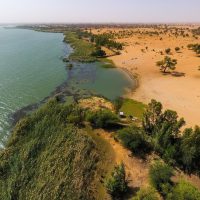
A team led by the University of Washington and Stanford University has discovered clues in the environment that help identify transmission hotspots for schistosomiasis, a parasitic disease that is second only to malaria in its global health impact. The research, publishing the week of Oct. 28 in the Proceedings of the National Academy of Sciences, uses rigorous field sampling and aerial images to precisely map communities that are at greatest risk for schistosomiasis.
Read more
Please join us in congratulating Sarah Converse who will be receiving the Department of the Interior’s Distinguished Service Award in Washington D.C. on September 12th.
Read more
SAFS is excited to announce that José M. Guzmán has been appointed our newest full-time lecturer.
Read more
SAFS is excited to announce that Camrin Braun will be joining us as our newest Assistant Professor.
Camrin has worked on movement ecology of top predators and biophysical interactions in the ocean for nearly a decade. He recently finished his PhD in the MIT-WHOI Joint Program in Oceanography and has been working as a Postdoctoral Research Scientist in the Air-Sea Interaction and Remote Sensing Department at the Applied Physics Lab (APL-UW).
Read more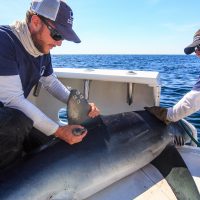
Last year, researchers at Woods Hole Oceanographic Institution (WHOI) and the Applied Physics Lab at the University of Washington (UW) discovered that when white sharks are ready to feast, they ride large, swirling ocean currents known as eddies to fast-track their way to the ocean twilight zone—a layer of the ocean between 200 and 1000 meters deep (656 to 3280 feet) containing the largest fish biomass on Earth. Now, according to a new study in Proceedings of the National Academy of Sciences (PNAS), scientists are seeing a similar activity with blue sharks, which dive through these natural, spinning tunnels at mealtime. The eddies draw warm water deep into the twilight zone where temperatures are normally considerably colder, allowing blue sharks to forage across areas of the open ocean that are often characterized by low prey abundance in surface waters.
Read more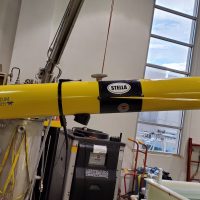
A multi-institution team consisting of the University of Washington School of Aquatic and Fishery Sciences (UW SAFS) Professor John Horne will deploy experimental technology next week to explore the deep scattering layers of the ocean. In addition to Horne, the UW team includes Ross Hytnen Jr. and summer intern Raymond Surya (a JISAO intern from the University of Michigan). Horne’s lab at SAFS uses active acoustic technologies to count and characterize aquatic organism distributions and dynamics throughout the world.
Read more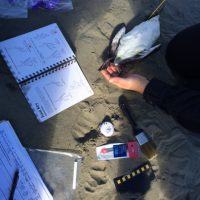
One of the most established hands-on, outdoor citizen science projects is the University of Washington-based Coastal Observation and Seabird Survey Team, COASST, which trains beachgoers along the West Coast, from California to Alaska, to monitor their local beach for dead birds. With about 4,500 participants in its 21-year history and roughly 800 active participants today, COASST’s long-term success is now the subject of scientific study in its own right. What makes people join citizen science projects, and what motivates people to stick with them over years?
Read more