Filter Results
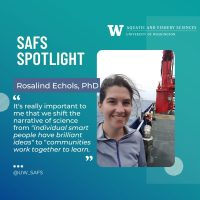
We spoke with Rosalind Echols, who gained her PhD from the School of Oceanography in Spring 2022 and is now pursuing her Postdoctoral Scholar studies at SAFS, as part of our Spotlight Series. Our Spotlight Series showcases the researchers at SAFS, how they got here, and the impact their research is having on the wider world.
Combining research with academic outreach, Rosalind pulls from her teaching background to engage a new generation of young scientists through the lens of “communities work together to learn”.
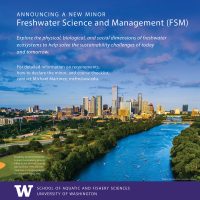
A new Minor has been launched at SAFS. Explore the physical, biological, and social dimensions of freshwater ecosystems to help solve the sustainability challenges of today and tomorrow, with the Freshwater Science and Management Minor.
Read more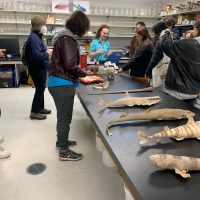
Ending the year with a special outreach event, the Students Explore Aquatic Sciences (SEAS) group hosted the Seattle Aquarium Youth Ocean Advocate volunteers.
With a tour of SAFS, the UW Fish Collection and other labs in the College of the Environment, the group – made up of local high school students – had insight into the extensive research and scientific projects across UW’s marine science programs.
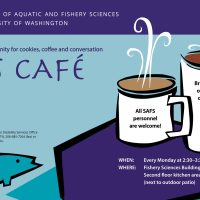
We’re pleased to announce that the SAFS Cafe is starting back up for winter quarter 2023!
The SAFS faculty are pleased to host you for hot drinks and treats, and a chance to take a quick break from your day to catch up with colleagues.
When: Mondays at 2:30 – 3:30
Where: FISH second floor kitchen and patio
What should I bring?
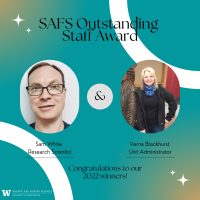
A huge congratulations to the winners of this year’s SAFS Outstanding Staff Awards.
Recognizing individuals who have brought enthusiasm, outstanding performance, and a special dedication to their roles, we’re happy to announce the two winners this year: Sam White and Verna Blackhurst.
Sam White – SAFS Outstanding Staff Award
A research scientist at SAFS since 2007, Sam White has been recognized for his dedication to mentoring students and staff both in labs and the wider community, his commitment to learning new approaches, and collaborative mentality which has contributed to the success of different research programs.
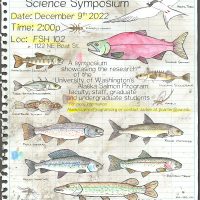
Taking place on Friday 9 December at 2pm, the agenda for the 2022 Alaska Salmon Program Annual Science Symposium has been announced. The event will be held in FSH 102, in the Fishery Sciences Building.
This symposium showcases the research of the UW School of Aquatic and Fishery Sciences’ Alaska Salmon Program undergraduate and graduate students, faculty, staff and visiting scientists.
Read more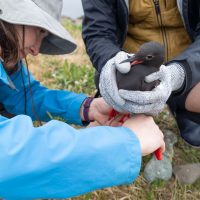
With its unique position spanning marine and freshwater environments, the School of Aquatic and Fisheries Science (SAFS) attracts researchers, scientists, scholars and students from a wide sea of disciplines.
The first in a new series of SAFS Spotlight, we spoke with Sarah Converse, Associate Professor at SAFS and Unit Leader of the U.S. Geological Survey, Washington Cooperative Fish and Wildlife Research Unit.
Last autumn, SAFS completed its first ever DEI Assessment, which highlighted key areas for SAFS to concentrate its future efforts to advance diversity, equity, and inclusion. Since that time, the Diversity Specialist and members of the Equity and Inclusion (EI) Committee have used the recommendations of the DEI Assessment and feedback from the SAFS community to draft the latest iteration of the SAFS EI Strategic Plan.
Read more
In September 2022, SAFS welcomed Amy Van Cise, a new assistant professor. Amy’s expertise focuses on the evolutionary ecology of marine mammals, which she studies using integrative approaches, including genomics, acoustics, and environmental DNA.
With a diverse career starting off with bachelor’s degrees in Marine Biology and Journalism, Amy’s previous studies, jobs, and research have taken her from New Hampshire and Peru to the Antarctic and Hawai‘i, and now to Washington.
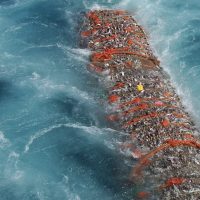
The School of Aquatic and Fishery Sciences and the College of the Environment hosted the annual live preview of the most recent assessment of Eastern Bering Sea (EBS) pollock—the target of one of the world’s largest fisheries.
Providing fishery stakeholders and the public the opportunity to learn about the status of the EBS pollock stock and discuss the science underlying the assessment, you can watch the recording of the event below.