Filter Results
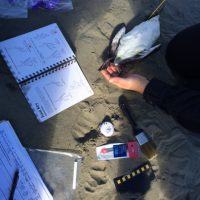
One of the most established hands-on, outdoor citizen science projects is the University of Washington-based Coastal Observation and Seabird Survey Team, COASST, which trains beachgoers along the West Coast, from California to Alaska, to monitor their local beach for dead birds. With about 4,500 participants in its 21-year history and roughly 800 active participants today, COASST’s long-term success is now the subject of scientific study in its own right. What makes people join citizen science projects, and what motivates people to stick with them over years?
Read more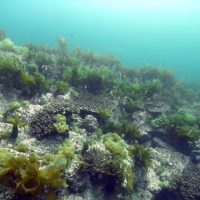
Coral reefs are retreating from equatorial waters and establishing new reefs in more temperate regions, according to new research published July 4 in the journal Marine Ecology Progress Series. The researchers found that the number of young corals on tropical reefs has declined by 85% — and doubled on subtropical reefs — during the last four decades.
Read more
Each year, our students, faculty and staff win regional, national, and international awards. Please join us in congratulating the latest group of award winners.
Read more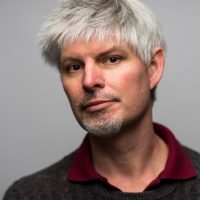
The six months since we published the previous issue of the newsletter have been exhilarating, exhausting, and just plain amazing as I hope you will see from these articles.
Read more
Mark Scheuerell is the newest member of the SAFS faculty. He joins SAFS as the Assistant Unit Leader, Fisheries, in the Washington Cooperative Fish and Wildlife Research Unit (WACFWRU), and an Associate Professor.
Read more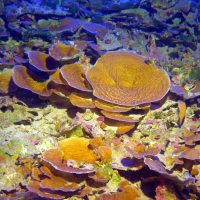
Just beyond where conventional scuba divers can go is an area of the ocean that still is largely unexplored. In waters this deep — about 100 to at least 500 feet below the surface — little to no light breaks through.
Read more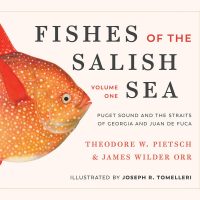
“Art and science collide magnificently in this monumental three-volume celebration of the 260 species of fishes that infuse the inland marine waters of Washington State and British Columbia, with hidden beauty, remarkable diversity and intriguing ways of living. This long-awaited work is a must-have not just for serious scientists and devotees of exquisite natural history artistry, but for any and all who find joy in exploring the wonders of nature.”―Sylvia Earle, National Geographic Explorer in Residence, Founder, Mission Blue
Read more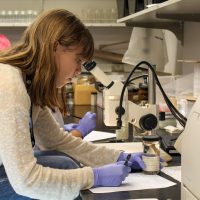
In a small room on the sub-level of the Fisheries Teaching and Research Building, families and friends crowd together, not unlike the countless jars of fish that pack the nearby shelves. In the center of the room is a table arranged with colorful posters and a group of girls who are excitedly answering questions. The eager onlookers are here to support their students, daughters, and friends, who are taking part in the Burke Museum’s Girls in Science (GiS) program. This science-fair style celebration is an opportunity for this quarter’s group of high school girls to present their findings after a rigorous six-week course where they identified “new” species.
Read more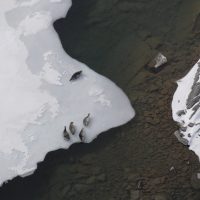
Hundreds of harbor seals live in Iliamna Lake, the largest body of freshwater in Alaska and one of the most productive systems for sockeye salmon in the Bristol Bay region. These lake seals are a robust yet highly unusual and cryptic posse. Although how the seals first colonized the lake remains a mystery, it is thought that sometime in the distant past, a handful of harbor seals likely migrated from the ocean more than 50 miles (80 kilometers) upriver to the lake, where they eventually grew to a consistent group of about 400. These animals are important for Alaska Native subsistence hunting, and hold a top spot in the lake’s diverse food web.
Read more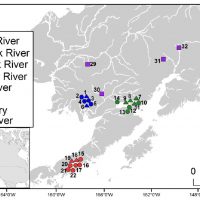
Sockeye salmon are found in many lakes and rivers in the northern Pacific Ocean, and have radiated outwards into regions formerly under glaciers during the most recent ice age. There are three main ecotypes: river-spawners (that migrate directly from the ocean to spawn in rivers); beach-spawners (that spawn on beaches in lakes) and tributary-spawners (that spawn in river tributaries that feed into lakes).
Read more