Filter Results
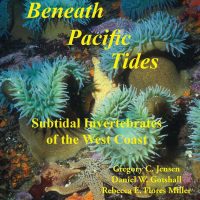
This winter, Greg Jensen is releasing his follow-up book, Beneath Pacific Tides: Subtidal Invertebrates of the West Coast. Like the charismatic crustaceans featured in his debut publication, the colorful and bizarre invertebrates found along the Pacific Coast are explored in this new user-friendly guide, featuring Jensen’s underwater photography.
Read more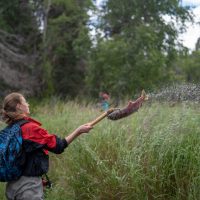
Tom Quinn and colleagues have found that two decades of carcasses — nearly 600,000 pounds of fish — tossed to the left side of Hansen Creek did have a noticeable effect: White spruce trees on that side of the stream grew faster than their counterparts on the other side.
Read more
A new study led by the University of Washington found that although dead whales are still valuable sources of fat and protein for some polar bears, this resource will likely not be enough to sustain most bear populations in the future when the Arctic becomes ice-free in summers, which is likely to occur by 2040 due to climate change. The results were published online Oct. 9 in the journal Frontiers in Ecology and the Environment.
Read more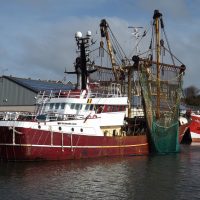
A new analysis that uses high-resolution data for 24 ocean regions in Africa, Europe, North and South America and Australasia shows that 14 percent of the overall seafloor shallower than 1,000 meters (3,280 feet) is trawled. Most trawl fishing happens in this depth range along continental shelves and slopes in the world’s oceans. The study focused on this depth range, covering an area of about 7.8 million square kilometers of ocean.
Read more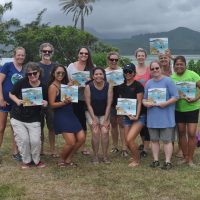
“I wanted to leave something behind to share with these kids. That’s why for me, it was important to have it be translated into Tahitian.”
— UW School of Aquatic and Fishery Sciences’ Jackie Padilla-Gamiño
A new study examines the overall environmental effects of eating different kinds of foods, comparing the energy required, greenhouse-gas emissions produced, release of nutrients harming water quality, and compounds causing acidification; and also looking at freshwater demands, and the use of pesticides and antibiotics. The review examined 148 life cycle analysis documents that cover the complete impacts of each food production source from start to finish.
Read moreSAFS professor Chelsea Wood has been awarded the University of Washington’s Distinguished Teaching Award, given annually to seven recipients for mastery of the subject matter; enthusiasm and innovation in the teaching and learning process; ability to engage students both within and outside the classroom; ability to inspire independent and original thinking in students and to stimulate students to do creative work; and innovations in course and curriculum design.
Read moreScientists currently classify groups of reef species by the depths at which they occur, with the so-called “mesophotic” species living at depths of 40-150 meters. Now, though, new data suggests that an additional depth zone is needed for reef species living in the coral reef twilight zone, to be called the “rariphotic” zone, covering the depths of 130-310 meters (400-1000 ft).
Read moreIn a world’s first, a mating pair of anglerfish is observed in the wild, evoking awe in SAFS professor Ted Pietsch, who comments in UW Today on the video footage by researchers Kirsten and Joachim Jakobsen aboard a submersible run by the Rebikoff-Nigeler Foundation. Only 14 females (and no males) of this species have ever been recorded, all collected in jars and none observed alive in the ocean.
Read moreSAFS Professor Chelsea Wood was awarded a Sloan Fellowship, awarded to early-career researchers in recognition of distinguished performance and a unique potential to make substantial contributions to their field. Prof. Wood is a prolific researcher who uses parasites and pathogens (both human and fish-based) to uncover fundamental ecological truths about the natural world. She will receive $65,000 to further her research initiatives, which includes using museum fish specimens as “parasite time capsules”, as reported in UW News.
Read more