Filter Results
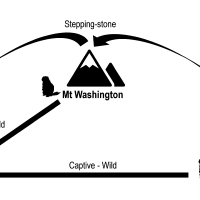
Captive breeding programs are intended to rebuild highly endangered populations, but a major problem is how to reintroduce captive-bred individuals back to their native habitat. Often, there is low survival of reintroduced individuals compared to wild-born individuals. Such is the case for the critically endangered Vancouver Island marmot, which had shrunk to just 30 individuals in 2003. A new experiment compares survival to breeding age for three strategies: transferring wild-born individuals, translocating captive-born individuals to wild habitat, and a new stepping stone strategy that involved first transplanting captive born individuals to a safe wild area with high survival before transferring them in their second year to the lower-survival final destination.
Read more
A new study led by the University of Washington found that although dead whales are still valuable sources of fat and protein for some polar bears, this resource will likely not be enough to sustain most bear populations in the future when the Arctic becomes ice-free in summers, which is likely to occur by 2040 due to climate change. The results were published online Oct. 9 in the journal Frontiers in Ecology and the Environment.
Read more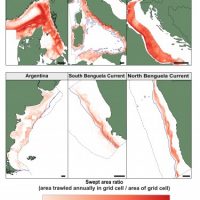
In recent years there has been a growing debate about what proportion of the oceans is fished, with estimates ranging from well above 50% to just 4%. A new paper now looks at one of the most widespread and damaging fishing types, trawling, where a net is dragged over the sea bottom to capture fish. The new method focuses on shallower continental shelves that are less than 1000 m in depth, finding that the trawling footprint varies hugely across regions from 0.4% of the area to more than 80%, with an average of 14% for all regions examined.
Read more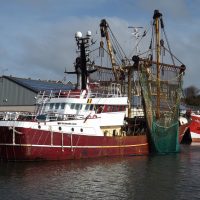
A new analysis that uses high-resolution data for 24 ocean regions in Africa, Europe, North and South America and Australasia shows that 14 percent of the overall seafloor shallower than 1,000 meters (3,280 feet) is trawled. Most trawl fishing happens in this depth range along continental shelves and slopes in the world’s oceans. The study focused on this depth range, covering an area of about 7.8 million square kilometers of ocean.
Read more
I grew up expecting to attend the University of Washington as had nearly all of my close relatives (my maternal grandmother graduated in 1909.) I applied to the College of Fisheries at the suggestion of Dixy Lee Ray (high school friend of my mother) and started in fall 1965 with the intent of becoming a marine biologist. The freshman class had over 100 students, of which possibly two were females, and it included SAFS own Charles “Si” Simenstad!
Read more
I almost didn’t make it as a biology major. During my junior year in Ecology and Evolutionary biology at UC San Diego, I realized I wasn’t very good at field work when a couple of graduate students I was volunteering for fired me. Twice. Fortunately I was saved by some ecological modeling classes that I was taking at the time from Mike Gilpin.
Read more
I never thought I would be a student at the age of 39, but there I was in Tom Quinn’s office discussing what classes to take for the fall of 2004 at SAFS. I quickly realized after having met several of my cohorts that I was by far one of the older students if not the oldest. My guess at the time was about 10 to 15 years older than most.
Read more
The first time I visited the SAFS, it was a misty and slightly cold Friday morning in November of 2001. I had flown in to meet with André Punt, a new research professor, about the possibility of becoming a graduate student in his lab. I was finishing up an MS degree at Moss Landing Marine Laboratories in the Monterey Bay area of California, where Novembers were a bit milder and less cloudy than this introduction to Seattle.
Read more
As a California native (mum’s the word!), I came to SAFS to study aquatic toxicology in 1983. I had knocked off an MS at San Diego State University and was lucky enough to complete a BS at Humboldt State. Prior to coming to SAFS, I was a marine biologist at the Naval Ocean Systems Center in San Diego and a deep-sea ecologist at the Scripps Institution of Oceanography in La Jolla, where I met my wife (Susan Picquelle) a NOAA statistician (Southwest Fisheries Science Center and Alaska Fisheries Science Center).
Read more
I was an MS student at SAFS from 2003–2007 and returned in 2014–2016 for a post-doc, both in Tim Essington’s lab. It goes without saying that the technical training I got from SAFS was of extremely high quality and prepared me for a career as a fisheries scientist at the Northwest Fisheries Science Center (NWFSC), where I am now. But, there were three intangible gifts SAFS gave me that I wasn’t expecting: entry into an elite club of respected fisheries scientists, an incredible set of colleagues, and life-long friendships.
Read more