Filter Results
Snake River salmonids are federally protected, but face a succession of dams to navigate from the ocean to the spawning grounds. The final dam in the sequence is the Lower Granite Dam. Ascending salmonids (sockeye salmon, steelhead, and Chinook salmon) all enter the fish ladders on the side of the dam, but some pass straight through and exit above the dam, while others are shunted off to one side and either released after a longer pathway, or held in tanks and sampled before being released to continue up the fish ladders.
Read more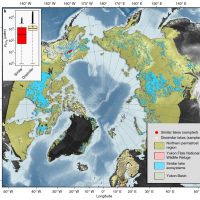
The dry northern reaches of Earth contain nearly half of all of the carbon originating in living matter, mostly stored in the frozen soils of the permafrost. It has been long thought that warming in the Arctic will result in this carbon being released from the soil and activated again, through the many lakes that are prominent features of the Arctic.
Read more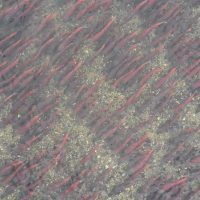
In 1906 while attending a livestock fair in Plymouth England, Sir Francis Galton witnessed an interesting contest where locals were trying to guess the correct weight of a slaughtered and dressed ox (think jellybeans in a jar, but for butchers). He examined all 800 guesses and calculated the median calling it the vox populi, or “voice of the people,” reasoning that this would cancel out outliers on either side of the true answer. Astonishingly, the median guess was extremely close–within .8%–of the weight measured by the judges and closer than any individual guess. “This started the idea of the wisdom of crowds, where if you have a whole bunch of independent guesses you can average them, cast off the errant guess on either side and hone in on the right answer,” said Dr. Andrew Berdahl one of the University of Washington School of Aquatic and Fishery Sciences’ newest faculty members.
Read more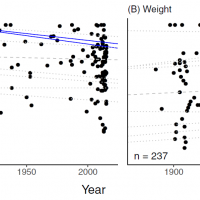
Shifting baselines is the concept that each human generation thinks “normal” conditions are those when they were growing up, and therefore only takes into account declines during their lifetime, instead of over multiple generations. A new paper now examines newspaper headlines over time to see whether declining fish size is detectable in fish described as superlatively enormous (e.g. “giant”, “huge”, or “monster”), finding declines in reports of lengths.
Read more
I was pleased to receive an email from André Punt inviting me to say a few words about my over 10 years at the then School of Fisheries at the UW. Some of the recurring treasured memories I have from those years include the following:
Completing a history of the Fisheries program at the UW that began with the wife of former Dean of the College of Fisheries Richard Van Cleve (who passed away in 1984) sharing a draft history that I used as the inspiration for the book Proceeds from the book were used to support programs in the School though I’m unaware as to whether that effort of love actually raised any significant income.
Read more
While still an undergraduate at UW in the late 1960s, I worked hourly as a lab helper in the College of Fisheries Laboratory of Radiation Ecology for Allyn Seymour (PhD, 1956) and Bob Ericksen (MS, 1966; PhD, 1971). This was followed by an eye-opening summer project at Petersburg, Alaska, in 1971 with Don Beyer (MS, 1973; PhD, 1977) under the supervision of Roy Nakatani (PhD, 1960). The project included fieldwork, lab analysis, and eventually, my first co-authored publication on the effects of salmon cannery waste.
Read more
In the spring of 1942, Bell Shimada, a senior in the College of Fisheries, was barred from the UW campus and incarcerated at the US Government Internment Camp in Minidoka, Idaho. From there, he volunteered for basic training with the 442nd Regimental Combat Team at Camp Shelby in Mississippi, and thereafter, received Japanese language and intelligence training at Camp Savage in Minnesota. Assigned to the Military Intelligence Service and embedded in the US Army Air Forces, Bell hopscotched behind the Pacific front line, ultimately serving in General MacArthur’s Supreme Commander for the Allied Powers headquarters in Tokyo until December 1946. After leaving service, Bell returned to the College of Fisheries and completed the remaining course work for his BS and MS degrees, followed eight years later by a PhD in 1956.
Read more
My 20-year relationship with SAFS started back when it was still SOF (School of Fisheries), and I was still in Mexico City. One of the co-advisors for my BS in Biology, and later supervisor at the National Fisheries Institute, was Pablo Arenas. A SAFS PhD graduate himself (1988), he was, at the time, organizing a hands-on workshop to be taught by Carl Walters and Ray Hilborn in Mérida, in English. Plans changed a couple of hours into the workshop when the need arose for an impromptu translator, and thus, I translated for, and mingled with, Carl and Ray for the next five days… Encouraged by Pablo, and advised by Ray, I arrived in Seattle for the first time, having been rejected by QERM (as predicted by Ray), accepted by SOF, funded by the Mexican government, and neglected to look up what the typical weather was like.
Read more
As I reflect on my time at SAFS, I consider it the most rewarding and influential time in my career. Ted, my committee members, SAFS faculty, and the other students were a singular group of mentors who supported my iterations through one new project after another. As a professor and mentor to students in my own lab now, I encourage students to take a similarly unconstrained approach and seek the mentorship of a diverse group of folks with different areas of expertise.
Read more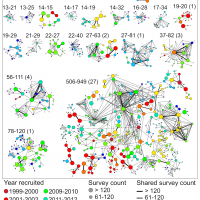
Citizen science, where the nonexpert public joins in freely to produce useful science, has grown to more than 2100 projects on the SciStarter website alone. These projects range from online identification of astronomical objects, to gaming-like projects predicting how proteins will fold (Foldit), to seasonal bird counts. One long-running project is COASST (Coastal Observation and Seabird Survey Team) where members of the public conduct monthly surveys of beach areas from California to Alaska looking for bird carcasses.
Read more