Filter Results
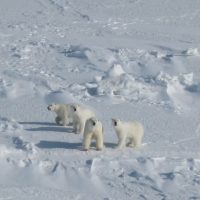
Each year, polar bears cycle through periods of intense feasting and prolonged fasting. For reproductive females, seasonal bulking is crucial – it fuels the winter denning and fasting period when they give birth. And when they emerge in spring, it gives biologists a chance to assess populations. A new study led by Sarah Teman explores whether A1c could reveal if a polar bear had recently denned, which – combined with the absence of cubs – may signal reproductive failure.
Read more
Building community among the different student groups at SAFS and Marine Biology—undergraduates, graduates and postdocs—the SAFS Undergrad Community Building Event was held was held for the fourth year running. Taking place on 13 May, undergraduates were invited to walk around and speak to grads and postdocs about different topics including grad school, what life looks like after graduation, and finding your way in science.
Read more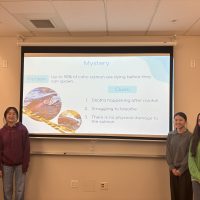
What brought a group of high schoolers to SAFS to teach a lesson on Pacific salmon and chemicals? It all started with an interest in ecology in 9th grade biology class, and a quest to find a relevant, local topic that they could base a research project on. Since then, Iris Zhang, Ivy Wei and Sylvia Mei from Redmond High School worked with Amirah Casey to research the topic, and developed a SEAS lesson centered on the effects of 6PPD-quinone on salmon.
Read more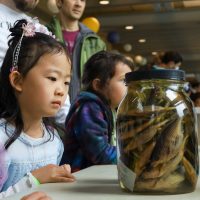
Returning for another successful year on Saturday 17 May, the UW Aquatic Sciences Open House had more than 1,000 attendees, with children of all ages plus their families. Organized by Students Explore Aquatic Sciences (SEAS), the event showcases the breadth of aquatic science taking place at the University of Washington and in the Puget Sound region with partner organizations.
Read more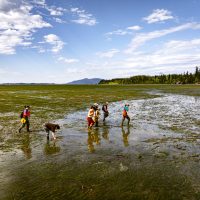
During low tide at Padilla Bay on a bright day in early May, you could find a class of UW undergraduates exploring the largest contiguous seagrass ecosystem in the lower 48. Why? To collect data to assess the habitat value of seagrass.
Read more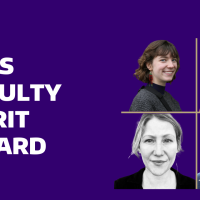
Congratulations to the four recipients of the SAFS Faculty Merit Award, awarded to outstanding scholars and members of the SAFS community: Emma Meyer (BS), Liz Allyn (MS), Amelia DuVall (PhD), and Kristin Privitera-Johnson (PhD).
Read more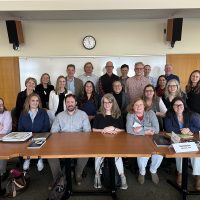
In a time of increasing calls for Washington judges to adjudicate water conflicts that reflect the State’s growth and development, two members of the University of Washington School of Aquatic and Fishery Sciences attended the Judicial Education Workshop on Water Resource Science, held on March 28, 2025, at Washington State University (WSU). Angela Dillon, a PhD student at SAFS, gave the judges an overview of the importance of water for the environment and fish, with an emphasis on salmon and the Electron Dam on the Puyallup River, while SAFS Professor, Mark Scheuerell, gave a tour of Lower Granite Dam on the Snake River, held on March 29.
Read more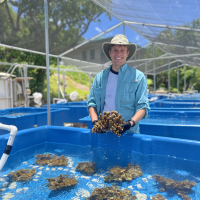
Bleaching. This complicated and foreboding term now lurks around every conversation about coral reefs. Impacted heavily by climate change and associated warming oceans, coral reefs experience bleaching when the algae that live in their tissues and contribute vitally to their growth are expelled, causing the corals to lose their color, and possibly their lives. Callum Backstrom, SAFS PhD student and one of UW’s 2025 Husky 100, is studying the resilience of certain corals to bleaching.
Read more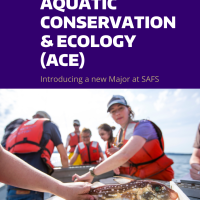
We’re excited to announce a new undergraduate degree in the School of Aquatic & Fishery Sciences (SAFS): Bachelor of Science in Aquatic Conservation and Ecology (ACE). Coming to UW in Autumn 2025.
The Aquatic Conservation and Ecology (ACE) degree is about the ecology of aquatic organisms, the rivers, lakes, and oceans in which they live, and how we conserve them for the benefit of people and the planet. This degree integrates the disciplines of ecology, evolution, and quantitative sciences and applies these principles to contemporary conservation and natural resource management issues.
Read more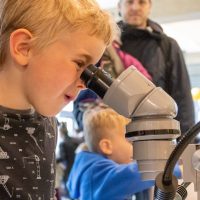
The UW Aquatic Sciences Open House is back on Saturday 17 May, offering a free and family-friendly day of hands-on learning to celebrate science and research that relates to water. Visitors can step on board a research boat used for local science, and experience real working science labs here at the university. We also have hands-on activities led by current UW students, staff, postdocs, and faculty across the College of the Environment and by organizations from the greater Seattle area.
Read more