Filter Results
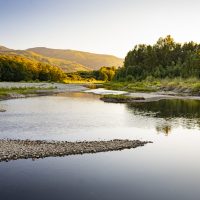
Most rivers in the United States flow with little real protection, even though they supply drinking water, support wildlife, and shape our landscapes. New research co-led by Julian Olden finds that nearly two-thirds of U.S. rivers lack safeguards for water quality, habitat, and biodiversity. The findings show how much of the nation’s river network remains exposed and how much work still lies ahead.
Read more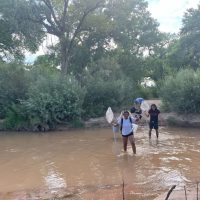
During the summer of 2025, members of the Wood Lab travelled to Albuquerque, New Mexico to work with Drs.Tom Turner and Sara Brant from University of New Mexico Museum of Southwestern Biology to quantify the change in parasite abundance and diversity in the Rio Grande over the past 72 years, a period stretching from 1938 to 2010.
Read more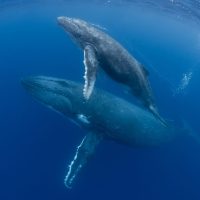
Long baleen whale mothers are more likely to have female calves than males, according to a new study led by the University of Washington. The findings, published by UW QERM student Zoe Rand and Professors Trevor Branch and Sarah Converse, contradict a popular evolutionary theory postulating that strong mammals benefit more from birthing males.
Read more
We welcome Andrea Burton to Marine Biology and the School of Aquatic and Fishery Sciences (SAFS), our newest faculty member. Andrea starts this month as an Assistant Teaching Professor. As a specialist in climate change biology, using molecular and ecological approaches to examine adaptive response to changing conditions, Andrea joins us from UCLA where she was a lecturer.
Read more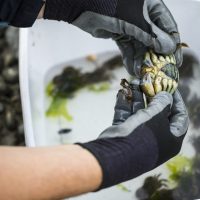
For almost a decade, the Washington Sea Grant Crab Team has been surveilling the advance of the invasive European green crab. In 2015, the team was formed to engage citizen scientists in a search for the first signs of an invasion into Puget Sound, with the first documented trap of a green crab taking place a year later in August 2016. They have now been found in more than 30 trapping sites. A new story in Salish Sea Currents features tracking efforts tracking efforts and research into the invasive crab.
Read more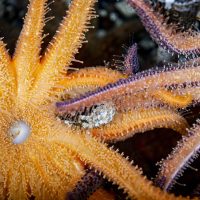
Until now, no one knew what caused the sea star wasting disease which wiped out populations along the West Coast starting in 2013. But an international research effort including scientists from the University of Washington has finally revealed the cause: a strain of the bacterium Vibrio pectenicida.
Read more
A new story in the Seattle Times shows just how alive the Seattle waterfront is, if you know where to look. From baby salmon to bull kelp, the renovations at the waterfront include a seawall where the public can look down at the fish-friendly seawall. The UW Wetland Ecosystem Team has been instrumental in this work, with continued monitoring of the site.
Read more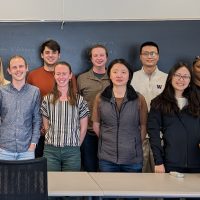
We’re living in a digital age, where the ability to find information (or even at times misinformation) is instant wherever you are in the world. This comes at the same time we’re at a critical juncture for climate research, where studying our changing world is more important now than ever. For SAFS graduate student, Amirah Casey, she knows that communication is vital to make impactful changes, and so applying for the PNW Climate Ambassadors program was a no-brainer.
Read more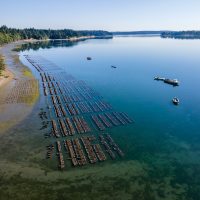
Seeking to understand the impacts of environmental stressors on Pacific oysters is the driving force behind a years-long research project involving scientists from the University of Washington and NOAA, and in collaboration with the oyster industry. Critical in aquaculture, Pacific oysters are the dominant oyster species grown on the US West Coast, with the industry in the Pacific Northwest alone valued at over $270 million a year.
Read more
A new video features how genetic metabarcoding is being used by the UW Whale And Dolphin Ecology Lab, led by Amy Van Cise, to understand and conserve southern resident killer whales in the Salish Sea.
Read more