Filter Results
The Seattle Times Reports “Puget Sound salmon are on drugs — Prozac, Advil, Benadryl, Lipitor, even cocaine. Those drugs and dozens of others are showing up in the tissues of juvenile chinook, researchers have found, thanks to tainted wastewater discharge.”
A research team of NOAA and UW scientists, including SAFS’ professor Dr. Graham Young, have documented levels of over 80 “chemicals of emerging concern”, pharmaceuticals and personal care products in estuarine waters and in juvenile chinook salmon and Pacific staghorn sculpin at sites in south Puget Sound impacted by discharge from wastewater treatment plants.
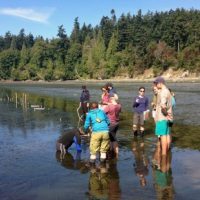
Students from around the country worked together as part of a class on the ecology of infectious marine diseases, taught by SAFS professors S. Roberts and C. Friedman, to examine how genes express themselves in sick and healthy sea stars.
Read more at UW News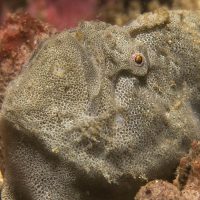
SAFS Professor Ted Pietsch and SAFS graduate student Rachel Arnold recently relocated an elusive tropical frogfish, last seen in Australia in 1980. After collecting specimens and testing the DNA, they discovered they’d found a new genus and species of fish, now named the red-fingered anglerfish.
Read more at UW TodayA new article, titled “Conservation challenges of predator recovery”, has been accepted for publication into Conservation Letters: A journal for the Society for Conservation Biology. This article is a result of the collaboration of SAFS post-doc Kristin Marshall, SMEA Professor Ryan Kelly, NOAA scientist and SAFS affiliate faculty Eric Ward, and NOAA scientists Jameal Samhouri and Adrian Stier.
Abstract
Predators are critical components of ecosystems.
A new study, lead by SAFS Prof. Tim Essington and published on April 6 in the Proceedings of the National Academy of Sciences, “implicates fishing in the collapse of forage fish stocks and recommends risk-based management tools that would track a fishery’s numbers and suspend fishing when necessary.” Read the full story on UW Today.
Read moreSeveral in the SAFS community have been working on a management strategy evaluation for Bristol Bay sockeye salmon. Findings were presented to the Alaska Board of Fish resulting in changes to seasonal management targets, reported by The Bristol Bay Times.
Last week the Department of Fish and Game adopted a wider range with raised upper ends for sockeye escapement goals in most Bristol Bay rivers.
This summer SAFS graduate student Emma Timmins-Schiffman along with Bryan Bartley (Bioengineering), and Lauren Vandepas (Biology) – have mentored a group of high school students from local Seattle schools. The students have accomplished some pretty impressive research projects over the course of the summer as they learn about interactions between the environment and local biota. On August 26 at 4 pm, the students will be presenting their research in a research symposium in FSH 102.
Read moreAs part of a monthly UnSeminar Series there will be a discussion June 27th 9:30 AM in the FTR 103 on Ocean Acidification.
The Open Notebook UnSeminar Series is focused on bringing together disparate research groups interested in sharing experiences, collaboration, and discussing issues related to large data sets, reproducibility, and science.
Everyone is welcome to attend. There will likely be a few slides, but primarily this is an informal discussion of what researchers are doing and how we might collaborate better.
Ecological response and physical stability of habitat enhancements along an urban armored shoreline
Jason D. Tofta, Corresponding author contact information, E-mail the corresponding author,
Andrea S. Ogstonb,
Sarah M. Heerhartza,
Jeffery R. Cordella,
Emilie E. Flemerb
http://dx.doi.org/10.1016/j.ecoleng.2013.04.022
Highlights
Shoreline enhancements seek to restore upon armored conditions.
In our study the two enhancements were a habitat bench and pocket beach.
Juvenile Chinook salmon and larval fishes used the habitat bench and pocket beach.
MN Dethier, *EA Sosik, *AWE Galloway, DO Duggins, *CA Simenstad. 2013. Feature Article, open access. Marine Ecology Progress Series 478:1-14.
http://www.int-res.com/abstracts/meps/v478/
*Authors from SAFS
Research on food webs increasingly relies on sampling biomarkers (stable isotopes and fatty acids) in consumers and their potential prey. In studies of macroalgal and seagrass biomarkers in the northeast Pacific, Dethier and coworkers found substantial variation in biomarkers across dates and sites.