Filter Results
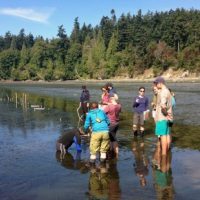
Students from around the country worked together as part of a class on the ecology of infectious marine diseases, taught by SAFS professors S. Roberts and C. Friedman, to examine how genes express themselves in sick and healthy sea stars.
Read more at UW News
UW Today featured SAFS professor Ted Pietsch, who co-authored a new report documenting all the fishes in the Salish Sea, from the familiar coho salmon to the intriguing dwarf wrymouth.
Read more at UW TodayRecent SAFS alumna Susan Harris spent 10 weeks at UW’s Friday Harbor Labs on San Juan island studying zoology and botany. UW Today featured a profile on Susan’s experience.
Read more at UW TodayA warm water mass in the Pacific Ocean is impacting forage species and stirring up more conversations about the need for ecosystem-based fisheries management. SAFS Professor Tim Essington weighs in.
Read more at Nature.com
SAFS Professor Ted Pietsch and SAFS graduate student Rachel Arnold recently relocated an elusive tropical frogfish, last seen in Australia in 1980. After collecting specimens and testing the DNA, they discovered they’d found a new genus and species of fish, now named the red-fingered anglerfish.
Read more at UW TodayA new article, titled “Conservation challenges of predator recovery”, has been accepted for publication into Conservation Letters: A journal for the Society for Conservation Biology. This article is a result of the collaboration of SAFS post-doc Kristin Marshall, SMEA Professor Ryan Kelly, NOAA scientist and SAFS affiliate faculty Eric Ward, and NOAA scientists Jameal Samhouri and Adrian Stier.
Abstract
Predators are critical components of ecosystems.
Oceanography and life history predict contrasting genetic population structure in two Antarctic fish species.
Evol Appl. 2015 Jun;8(5):486-509
Authors: Young EF, Belchier M, Hauser L, Horsburgh GJ, Meredith MP, Murphy EJ, Pascoal S, Rock J, Tysklind N, Carvalho GR
Abstract
Understanding the key drivers of population connectivity in the marine environment is essential for the effective management of natural resources. Although several different approaches to evaluating connectivity have been used, they are rarely integrated quantitatively.
Related Articles
Practical science communication strategies for graduate students.
Conserv Biol. 2014 Oct;28(5):1225-35
Authors: Kuehne LM, Twardochleb LA, Fritschie KJ, Mims MC, Lawrence DJ, Gibson PP, Stewart-Koster B, Olden JD
Abstract
Development of skills in science communication is a well-acknowledged gap in graduate training, but the constraints that accompany research (limited time, resources, and knowledge of opportunities) make it challenging to acquire these proficiencies.
A global database of lake surface temperatures collected by in situ and satellite methods from 1985-2009.
Sci Data. 2015;2:150008
Authors: Sharma S, Gray DK, Read JS, O’Reilly CM, Schneider P, Qudrat A, Gries C, Stefanoff S, Hampton SE, Hook S, Lenters JD, Livingstone DM, McIntyre PB, Adrian R, Allan MG, Anneville O, Arvola L, Austin J, Bailey J, Baron JS, Brookes J, Chen Y, Daly R, Dokulil M, Dong B, Ewing K, de Eyto E, Hamilton D, Havens K, Haydon S, Hetzenauer H, Heneberry J, Hetherington AL, Higgins SN, Hixson E, Izmest’eva LR, Jones BM, Kangur K, Kasprzak P, Köster O, Kraemer BM, Kumagai M, Kuusisto E, Leshkevich G, May L, MacIntyre S, Müller-Navarra D, Naumenko M, Noges P, Noges T, Niederhauser P, North RP, Paterson AM, Plisnier PD, Rigosi A, Rimmer A, Rogora M, Rudstam L, Rusak JA, Salmaso N, Samal NR, Schindler DE, Schladow G, Schmidt SR, Schultz T, Silow EA, Straile D, Teubner K, Verburg P, Voutilainen A, Watkinson A, Weyhenmeyer GA, Williamson CE, Woo KH
Abstract
Global environmental change has influenced lake surface temperatures, a key driver of ecosystem structure and function.
A global database of lake surface temperatures collected by in situ and satellite methods from 1985-2009.
Sci Data. 2015;2:150008
Authors: Sharma S, Gray DK, Read JS, O’Reilly CM, Schneider P, Qudrat A, Gries C, Stefanoff S, Hampton SE, Hook S, Lenters JD, Livingstone DM, McIntyre PB, Adrian R, Allan MG, Anneville O, Arvola L, Austin J, Bailey J, Baron JS, Brookes J, Chen Y, Daly R, Dokulil M, Dong B, Ewing K, de Eyto E, Hamilton D, Havens K, Haydon S, Hetzenauer H, Heneberry J, Hetherington AL, Higgins SN, Hixson E, Izmest’eva LR, Jones BM, Kangur K, Kasprzak P, Köster O, Kraemer BM, Kumagai M, Kuusisto E, Leshkevich G, May L, MacIntyre S, Müller-Navarra D, Naumenko M, Noges P, Noges T, Niederhauser P, North RP, Paterson AM, Plisnier PD, Rigosi A, Rimmer A, Rogora M, Rudstam L, Rusak JA, Salmaso N, Samal NR, Schindler DE, Schladow G, Schmidt SR, Schultz T, Silow EA, Straile D, Teubner K, Verburg P, Voutilainen A, Watkinson A, Weyhenmeyer GA, Williamson CE, Woo KH
Abstract
Global environmental change has influenced lake surface temperatures, a key driver of ecosystem structure and function.