Filter Results
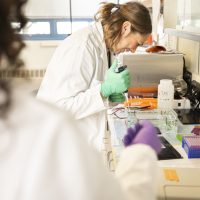
Working with Assistant Professor Amy Van Cise in the Whale and Dolphin Ecology Lab, Arial Brewer (PhD, SAFS) and Mollie Ball (BS, Marine Biology) were preparing metabarcoding libraries to study marine mammals. This means barcoding DNA (or eDNA) in a manner that allows for the simultaneous identification of many taxa within the same sample.
Read more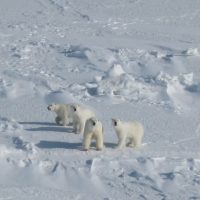
Each year, polar bears cycle through periods of intense feasting and prolonged fasting. For reproductive females, seasonal bulking is crucial – it fuels the winter denning and fasting period when they give birth. And when they emerge in spring, it gives biologists a chance to assess populations. A new study led by Sarah Teman explores whether A1c could reveal if a polar bear had recently denned, which – combined with the absence of cubs – may signal reproductive failure.
Read more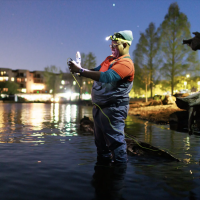
Wearing a bright orange and gray dry suit, Ashley Townes stepped into the murky water of Lake Washington under a yellow moon, at a time when most others are asleep. A recent Seattle Times story features Ashley’s work as a fish biologist and a member of a grassroots group of neighbors who have advocated and fundraised for years to restore Be’er Sheva Park, to restore the shoreline and salmon habitat.
Read more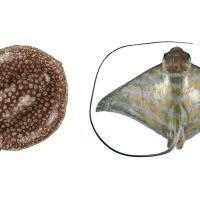
A UW mechanical engineering student’s research is revealing how generative design can be used to analyze the complex shapes found in biological rigid structures like skeletons. John Michael Racy, along with co-authors including Adam Summers, turned to generative design to understand the complex forces that shape the elements of the stingray fin skeleton.
Read more
Building community among the different student groups at SAFS and Marine Biology—undergraduates, graduates and postdocs—the SAFS Undergrad Community Building Event was held was held for the fourth year running. Taking place on 13 May, undergraduates were invited to walk around and speak to grads and postdocs about different topics including grad school, what life looks like after graduation, and finding your way in science.
Read more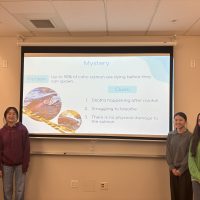
What brought a group of high schoolers to SAFS to teach a lesson on Pacific salmon and chemicals? It all started with an interest in ecology in 9th grade biology class, and a quest to find a relevant, local topic that they could base a research project on. Since then, Iris Zhang, Ivy Wei and Sylvia Mei from Redmond High School worked with Amirah Casey to research the topic, and developed a SEAS lesson centered on the effects of 6PPD-quinone on salmon.
Read more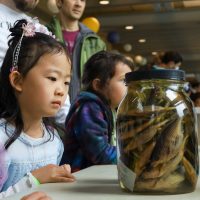
Returning for another successful year on Saturday 17 May, the UW Aquatic Sciences Open House had more than 1,000 attendees, with children of all ages plus their families. Organized by Students Explore Aquatic Sciences (SEAS), the event showcases the breadth of aquatic science taking place at the University of Washington and in the Puget Sound region with partner organizations.
Read more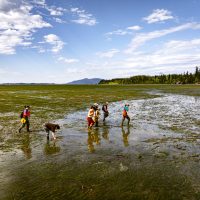
During low tide at Padilla Bay on a bright day in early May, you could find a class of UW undergraduates exploring the largest contiguous seagrass ecosystem in the lower 48. Why? To collect data to assess the habitat value of seagrass.
Read moreTulalip Tribes is hiring a full time temporary Wetland/Ecological Restoration Technician to work as an assistant to the Wetland Program Coordinator. The Wetland Technician will conduct field work in vegetation monitoring and management including developing skills in plant identification, invasive species control, maintaining stream and wetland restoration projects, data collection and management, and use of field data collection equipment including GPS.
Read more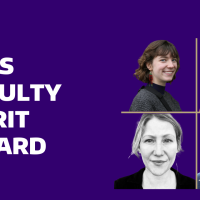
Congratulations to the four recipients of the SAFS Faculty Merit Award, awarded to outstanding scholars and members of the SAFS community: Emma Meyer (BS), Liz Allyn (MS), Amelia DuVall (PhD), and Kristin Privitera-Johnson (PhD).
Read more