Filter Results

Normally I spend much of this “From the Director” celebrating the various successes, innovations, and discoveries by our School’s talented faculty, students and staff. This time, I also want to acknowledge the difficult circumstances we face. Like many of our peer institutions, SAFS and the UW are facing serious challenges: a state budget deficit, shifts in federal spending priorities, and rising personnel costs. These realities have created a budgetary “perfect storm.”
Read more
We welcome Andrea Burton to Marine Biology and the School of Aquatic and Fishery Sciences (SAFS), our newest faculty member. Andrea starts this month as an Assistant Teaching Professor. As a specialist in climate change biology, using molecular and ecological approaches to examine adaptive response to changing conditions, Andrea joins us from UCLA where she was a lecturer.
Read more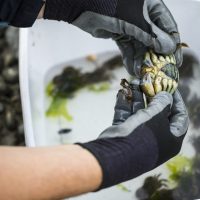
For almost a decade, the Washington Sea Grant Crab Team has been surveilling the advance of the invasive European green crab. In 2015, the team was formed to engage citizen scientists in a search for the first signs of an invasion into Puget Sound, with the first documented trap of a green crab taking place a year later in August 2016. They have now been found in more than 30 trapping sites. A new story in Salish Sea Currents features tracking efforts tracking efforts and research into the invasive crab.
Read more
Fullbright Scholar, Science contributor, freshwater biologist. These are some of the ways to describe Aashna Sharma, who is currently working with Dr. Julian Olden at SAFS as part of her two-year postdoctoral fellowship. From the foothills of the Himalayas in India, Aashna was recently inspired by the Past as Prologue feature in Science that highlights how different scientists from around the world are shaped by their family and background, and submitted a piece herself.
Read more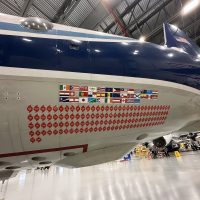
Last year, we spoke with SAFS undergrad, Michael Han, about receiving the NOAA Hollings Scholarship and where this would take him over the next year. This summer, Michael has split his time between NOAA’s HQ in Silver Spring, Maryland and NOAA’s Aircraft Operations Center (AOC) in Lakeland, Florida. His internship has been focused on NOAA’s Hurricane Hunters, aircraft which fly into the world’s worst weather to collect data which assists forecasters in making accurate predictions during hurricanes, and helps hurricane researchers achieve a better understanding of storm processes.
Read moreThe International Pacific Halibut Commission (IPHC) is seeking 2–3 undergraduate students for a volunteer position in their otolith lab. Volunteers will take images of whole and cross-sectioned otoliths using a mounted camera. These photos will train an image classification model to determine Pacific halibut ages based on photos of their otoliths. Coupled with traditional aging methods, this model will help produce more high-quality ages, making the stock assessment process more efficient.
Read more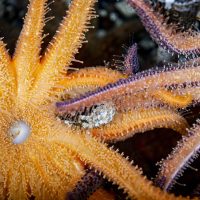
Until now, no one knew what caused the sea star wasting disease which wiped out populations along the West Coast starting in 2013. But an international research effort including scientists from the University of Washington has finally revealed the cause: a strain of the bacterium Vibrio pectenicida.
Read more
A new story in the Seattle Times shows just how alive the Seattle waterfront is, if you know where to look. From baby salmon to bull kelp, the renovations at the waterfront include a seawall where the public can look down at the fish-friendly seawall. The UW Wetland Ecosystem Team has been instrumental in this work, with continued monitoring of the site.
Read more
We’re living in a digital age, where the ability to find information (or even at times misinformation) is instant wherever you are in the world. This comes at the same time we’re at a critical juncture for climate research, where studying our changing world is more important now than ever. For SAFS graduate student, Amirah Casey, she knows that communication is vital to make impactful changes, and so applying for the PNW Climate Ambassadors program was a no-brainer.
Read more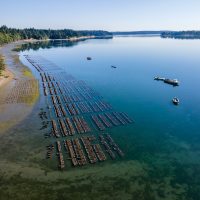
Seeking to understand the impacts of environmental stressors on Pacific oysters is the driving force behind a years-long research project involving scientists from the University of Washington and NOAA, and in collaboration with the oyster industry. Critical in aquaculture, Pacific oysters are the dominant oyster species grown on the US West Coast, with the industry in the Pacific Northwest alone valued at over $270 million a year.
Read more