Filter Results
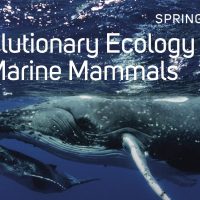
In a new class taught by Dr. Amy Van Cise, students can dive into the world of evolutionary ecology of marine mammals.
FISH 497B MWF 12:30–1:20 pm
Explore the diverse and integral ecological roles played by marine mammals in our global aquatic ecosystems, from coastal and riverine to open ocean and deep ocean environments.
Examine the major evolutionary adaptations driving the radiation of mammals into the aquatic environment and into a diverse array of ecological niches.
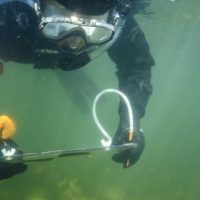
As part of the UW Wetland Ecosystem Team’s Seattle Seawall Fish Monitoring Program, an underwater video from 2022 has been released.
Documenting what lies beneath in Year 5 of the project in 2022, the video is compiled from snorkel and SCUBA surveys to monitor effectiveness of the Seattle seawall rebuild for improving habitat for juvenile salmon and other nearshore fishes.
For more information visit http://depts.washington.edu/wetlab/
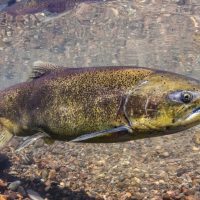
As part of the Climate Talk series by Radio Tacoma, Dr. Mark Scheuerell from SAFS joined to speak about PNW salmon populations and what they tell us about the state of our environment. Click the link and scroll down to listen to the episode.
Read more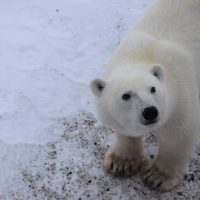
On International Polar Bear Day, the plight of these apex predators could not be more evident, as a result of a myriad of threats to their existence due to climate change.
As their name suggests, polar bears live in the Arctic polar regions of Canada, Greenland, Russia and Alaska. Kristin Laidre, a UW scientist at SAFS, shares that polar bears require ice for almost every aspect of their existence, including feeding, moving, breeding and in some places, maternity denning.
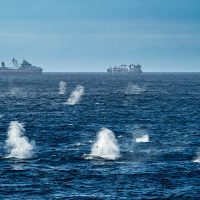
In a study led by Stanford University and Lindblad Expeditions, and co-authored by Trevor Branch from SAFS, scientists observed close to 1,000 fin whales foraging near Antarctica, while fishing vessels trawled for krill in their midst.
Read more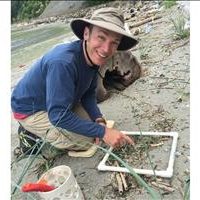
Read about his involvement in designing the replacement seawall along Seattle’s central waterfront and the key design features devised to make the environment as hospitable as possible for juvenile salmon, especially Chinook and Chum salmon, as they out-migrate from the river system to the ocean.
Read more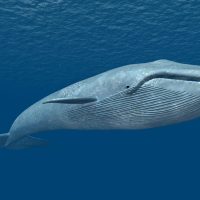
The biggest animals to have ever lived on our planet, blue whales are a charismatic species found across the world’s oceans.
Ranging in size from 79 ft in the Indian Ocean’s pygmy blue whale subspecies to more than 100 ft in Antarctic blue whales, these marine mammals were once hunted to near extinction.
In order to reconstruct past level of whales and discover if blue whale populations were recovering or not after the banning of commercial whaling in the 1980s, scientists have developed models that explain both old whaling catch records and modern-day counts.
Growing up on the shores of Lake Michigan, Ben Makhlouf, now a researcher at SAFS, started off as an Ecology undergrad at UW. Taking a limnology course during his studies, he was inspired to get involved in research in Alaska when seeing someone with an Alaska Salmon Program t-shirt on. It amazed him that people were able to visit and work there.
Read more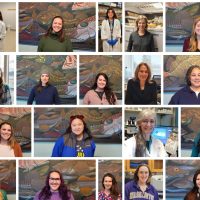
From salmon ecologists and scientific divers to conservation geneticists and marine biologists, the halls of UW’s School of Aquatic and Fishery Sciences and Marine Biology are filled with women in science.
Some are just beginning their journey with undergraduate degrees while others are pursuing research as retired professors, and we’re celebrating them all and the diversity among them.
For the UN International Day of Women and Girls in Science, we share thoughts from more than 20 women, about their inspirations, the barriers they’ve overcome, and tips for being women in science.
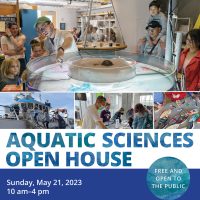
The Open House offers a free and family-friendly afternoon of hands-on learning to celebrate science and research that relates to water.
Read more