Filter Results
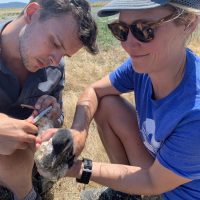
Did you know that seabirds link the ocean and the land? They forage for food in the ocean and nest on the land, making them an important part of two very different ecosystems.
At the booth organized by the Converse and Gardner labs at the SEAS Open House, you will learn about seabirds and the methods we use to study them.
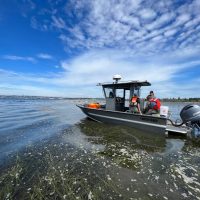
What fieldwork did the Applied Ecology Lab get up to last summer? Mark Scheuerell, Associate Professor at SAFS, shared insights into Washington’s aquaculture and some of the research underway at his lab.
Washington is the nation’s leading producer of farmed clams, oysters, and mussels, contributing nearly $200 million to our economy and supporting over 1900 jobs. Accordingly, there is demand for growth within the shellfish aquaculture industry, but a key impediment to doing so sustainably is that we don’t have a firm grasp on the ecological implications of converting nearshore habitat to shellfish production.
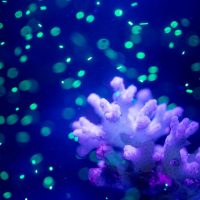
Tiny pieces of plastic in the ocean might seem innocuous on their own, but their growing presence is a frustrating issue facing marine ecosystems. The particles’ small size makes them difficult to clean up, and it also allows them to easily burrow into marine environments or even get ingested by ocean organisms.
Read more
Now in its 12th year of being held at SAFS, a workshop led by graduate students to support applicants for the National Science Foundation (NSF) Graduate Research Fellowship Program (GRFP) is celebrating the successful award to five students this year.
The NSF GRFP aims to ensure the quality, vitality, and diversity of the scientific and engineering workforce of the US and broaden participation in science and engineering of underrepresented groups.

We are excited to announce that the Equity & Inclusion Committee has released the “Undergraduate Mentorship Guide for Community-Building”, which is now available on the SAFS DEI webpage! The guide is designed to help undergraduate students and their mentors navigate the mentoring relationship and achieve success.
This mentorship guide is intended primarily for undergraduate students (mentees) and for graduate students, postdocs, and staff, (who may serve as mentors) at SAFS.
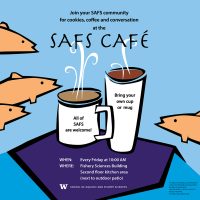
Join us every Friday this Spring for the SAFS Cafe.
The SAFS faculty are pleased to host you for hot drinks and snacks, and a chance to take a quick break from your day to catch up with colleagues.
When: Fridays at 10am
Where: FISH second floor kitchen and patio
What should I bring? Bring your coffee or tea and stop by for a snack and a chat!

Join your SAFS Community for a special All Hands Meeting where you can ask all of your burning questions!
Want to know more about the life of a post doc? Interested in the graduate program process? Always wanted to ask a faculty member what their day looks like? Wondering what are some of the important topics impacting our school? Want to know how SAFS is working to be more inclusive?
The SAFS Boots in the Mud fund is a special opportunity to provide our students with materials and equipment needed for immersive learning opportunities.
Read more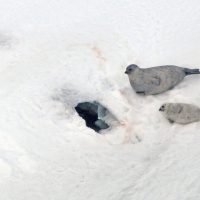
In the Arctic, where temperatures are rising at nearly four times the global average, a collaborative effort, combining Indigenous Knowledge with multidisciplinary science has been used to investigate the denning habitat selection of Alaska’s ringed seals.
During the Ikaaġvik Sikukun (Iñupiaq for “Ice Bridges”) project, researchers from the University of Washington School of Aquatic and Fishery Sciences (SAFS), Lamont-Doherty Earth Observatory of Columbia University, University of Alaska Fairbanks, the Native Village of Kotzebue, NOAA, and Farthest North Films collaborated with an Elder Advisory Council of Iñupiaq Qikiqtaġruŋmiut Elders with extensive personal history of subsistence hunting and experience on sea ice.
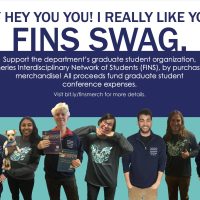
Ever wondered how money raised from the sale of FINS merchandise gets used? Look no further—here are some recent stories from SAFS students who have directly benefited from funds raised by the Fisheries Interdisciplinary Network of Students (FINS), housed at the UW School of Aquatic and Fishery Sciences.
One of the best ways for graduate students to present their research to an extensive, global audience and interact with national and international colleagues is to attend conferences relevant to their field of study.