Filter Results
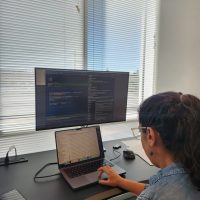
The use of eDNA methods is a new and exciting area of research. Tania Valdivia, a post-doctoral student in the Whale and Dolphin Ecology Lab, is working on a large marine project under the guidance of Amy Van Cise from SAFS, and Ryan Kelly from the School of Marine and Environmental Affairs (SMEA).
The project focuses on the application of eDNA methods to detect and identify the spatial distribution of marine mammals and their prey in the California Current.

Returning on Tuesday 10 October at 3.30pm, join your fellow SAFS community for hot drinks, tasty treats, and conversation each week during the Fall Quarter.
Are you a student? Staff member? Faculty? Researcher? Take a break from your day and get to know others working at SAFS. All are welcome!
Tuesdays at 3.30pm in the second floor kitchen area near the patio.
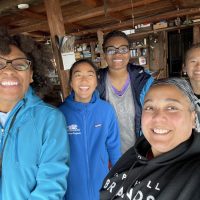
Spending the summer at Friday Harbor Labs (FHL), SAFS grad student Chris Mantegna mentored four students – two as part of the NSF-funded Research Experience for Undergrads-Blinks (REU) program and two as part of the Doris Duke Conservation Scholars Program (DDCSP). During the program, students get to collaborate on a research project with their scientist-mentor to build marine research skills.
Specifically geared towards enhancing diversity within the marine sciences, the program welcomes students from underrepresented groups.
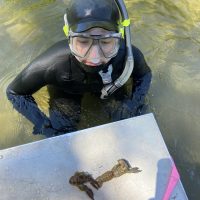
Claire Vaage, a masters student in the Freshwater Ecology and Conservation Lab advised by Julian Olden, spoke with us about her summer field season in Central Oregon.
Spending 5 weeks during this summer in Oregon, I led a research team of two to four people at a time. Each day we conducted snorkel surveys and collected samples of freshwater macroinvertebrates and vegetation.

Settling into her new role as Associate Director and Graduate Program Coordinator of SAFS, Chelsea Wood is excited to help SAFS scale up its efforts to build community. “Learning and growth happen when people feel a sense of belonging, and that can be fostered by embedding them in a strong community,” she says. “Strong academic communities are tightly networked, with many and robust connections between individual people and across lab groups.
Read more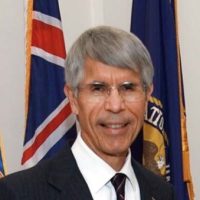
He obtained a Ph.D. in Fisheries Science from the University of Washington in 1972, and his research focused on marine mammal biology.
Read more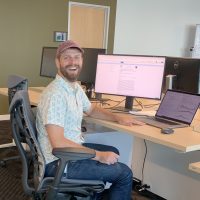
In the world of fisheries management systems, many do not account for predator-prey interactions that scientists know can have big impacts on the dynamics and available biomass of commercially targeted species.
For his dissertation work as part of the Gulf Of Alaska Climate Integrated Modeling Project (GOA-CLIM), Grant Adams from the Punt Lab at SAFS, has been developing multi-species population dynamics models for the Gulf of Alaska.
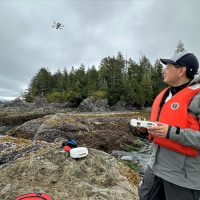
Welcoming the newest SAFS Professor and Associate Dean for Diversity, Equity and Inclusion for the College of the Environment, we spoke with Corey Garza. He shares his plans to enhance College diversity, what he’s most excited about by joining SAFS, and insight into his world of research using drones.
What plans do you have for Diversity, Equity and Inclusion (DEI) as Associate Dean?
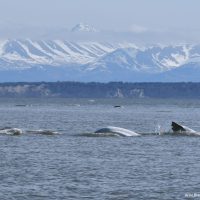
Known as the canaries of the sea for their highly vocal nature, beluga whales are found across the Arctic and sub-Arctic. There are 21 beluga populations worldwide, with five populations found in Alaska. Of these, the Cook Inlet beluga population is the most endangered, with current estimates hovering around the 300 mark. A highly diverged population, the Cook Inlet belugas are geographically and genetically isolated, remaining in Cook Inlet year-round.
Read more
Position now closed
A new position is opening for an Aquatic Food System Data Scientist in incoming Professor Jessica Gephart’s lab.
The Aquatic Food System Data Scientist will join an interdisciplinary team focused on aquatic food production and trade. Aquatic food plays an important role in global food security, providing nearly 20% of global animal protein and supplying essential fatty acids and micronutrients.