Filter Results

Chris Mantegna writes a Nature World View piece, saying amid the data deluge provided by lab-based techniques, such as environmental-DNA analysis, true connection still comes only in the outdoors.
Read more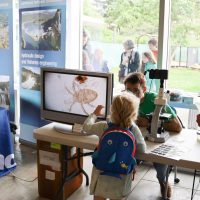
Bringing aquatic science to life for the people of Seattle for the sixth time, the UW Aquatic Sciences Open House returns for a free, family-friendly day of fun on Saturday 18 May. Open to everyone – from toddlers to teenagers to adults – we’re showcasing the amazing breadth of wet sciences at the University of Washington.
Kicking off at 10am, we’ve got fan favorites like exploring the live aquarium tanks which are home starfish, telling the difference between native versus invasive crabs, and peering through microscopes to see tiny marine organisms.
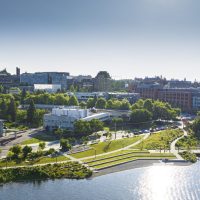
An analysis of 1,500 institutions in nearly 100 locations across the globe, places University of Washington Earth and Marine Sciences program at no. 10, which includes Aquatic and Fishery Sciences.
Read more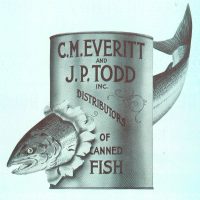
Alaskan waters are a critical fishery for salmon, and scientists want to know the impact of climate change. As a UW SAFS doctoral student, Natalie Mastick investigated Alaskan marine food webs using an unorthodox source: old cans of salmon, from four species all caught over a 42-year period.
Read more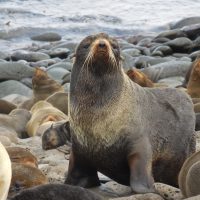
In a new book providing a guided walkthrough and toolbox to conduct population and ecosystem modeling at high-spatial resolution, James Thorson (SAFS alum and affiliate faculty, and Statistical Ecologist at NOAA) has co-authored Spatio-Temporal Models for Ecologists with Kasper Kristensen. Coming up with the idea for the book during a meeting at SAFS almost a decade ago, we sat down with James to find out more about why it’s a useful tool for ecologists.
Read more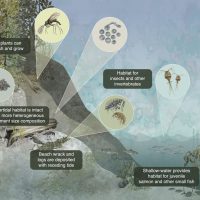
Stretching from Admiralty Inlet to the city of Olympia, Puget Sound has 1330 miles of shoreline, of which 25% is armored. In a new paper, SAFS Research Scientist Simone Des Roches, led a team studying the impact of armor removal and other restoration activities on shorelines through time in Puget Sound locations.
Read more
Recently contributing to a special Oceanography issue titled ‘Building Diversity, Equity, and Inclusion in the Ocean Sciences’ was Dr. Xochitl Clare, a postdoctoral scholar at SAFS.
Read more
Spring into Spring Quarter with SAFS Cafe, back every Wednesday at 3.30pm.
Whether you’re a student, researcher, faculty, or member of staff, all are invited for cookies, coffee, and conversation every week.
Join us in the 3rd floor kitchen in the Fishery Sciences Building.
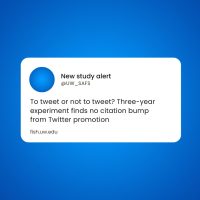
In a controlled experiment spanning three years and involving 11 scientists from a range of life science disciplines, a new study published in PLOS ONE demonstrates that sharing a paper on Twitter did not increase citations.
It has long been asserted that papers shared on social media platforms, such as X (formerly called Twitter), receive a higher number of citations. However, a team of leading science communicators, led by University of Washington School of Aquatic and Fishery Sciences Professor Trevor Branch, with a combined total of 223,000 followers at the end of the experiment, wanted to explore whether increased citations was actually caused by tweeting about them, or was a correlation due to other factors such as the quality of the paper and the importance of the information in the paper.

Since 2017, Kristin Privitera-Johnson has been working with André Punt on creating a population model for North Pacific humpback whales as part of the work of the Scientific Committee of the International Whaling Commission. This population is modeled using various datasets – new, old, hidden, lost. Working with other members on their team, they’re uncovering new ways to deliver deeper insights into this population of humpbacks, including use of genetic and photo IDs data on population connectivity.
Read more