Filter Results
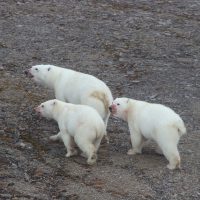
A meeting of the IUCN/SSC Polar Bear Specialist Group (PBSG) was held at SAFS on 10-14 June 2024, co-chaired by Professor Kristin Laidre.
Read more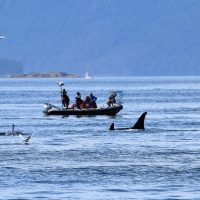
Over the last two decades, there has been huge growth in the availability of different ‘omics methods used to study marine mammals. A new paper published in Marine Mammal Science, involving 19 scientists from around the globe, has laid out best practices for collecting and preserving marine mammal biological samples in the ‘omics era.
Read more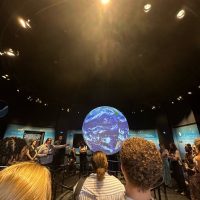
Each year, hundreds of students apply for the competitive NOAA Ernest F. Hollings Undergraduate Scholarship. Read our Q&A with SAFS undergrad, Michael Han, who along with three other College of the Environment students, was chosen as a 2024 NOAA Hollings Scholar and attended orientation in the nation’s capital.
Read more
In a new episode of UW Environment’s Fieldsound podcast, they’re joined by those behind the GEODUC program, which boosts belonging in geosciences for transfer students.
Read more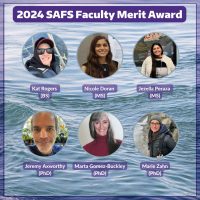
We’re happy to announce this year’s Faculty Merit Award winners, given annually to graduating students at all ranks in recognition of exceptional achievement and contributions to the School of Aquatic and Fishery Sciences. This is by far the most prestigious of the many awards conferred by the School to students, where the nominations come directly from SAFS faculty.
Read more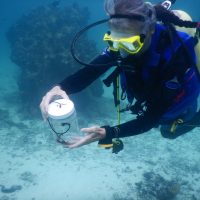
Swimming around tropical coral reefs in a colorful array are an ever-changing multitude of fishes, some in schools of hundreds, others in pairs, and ones that prefer their own company. These are the fishes divers see on a heathy coral reef, but they are often only half of the diversity found in the reef’s fishes. The “hidden half” are the cryptobenthic fishes.
Read more
We are pleased to announce the recipients of the 2024 SAFS DEIJ and Community Service Recognition Award: Julia Indivero and Claire Vaage.
Read more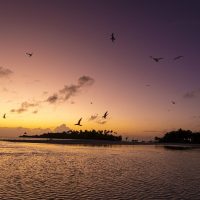
From microplastics to seabirds, and everything in between, Tetiaroa offers new insights on tropical ecosystems for UW Professors and researchers.
Read more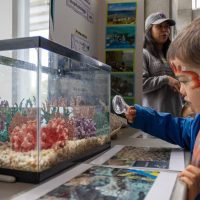
The number of people diving into aquatic sciences during the 2024 Open House on 18 May more than doubled this year, with 1,200 visitors of all ages joining us for a day of hands-on activities.
Read more
Eric Essington, UW Biology senior, has been working on his independent research project in the Roberts Lab for the past year, looking into a familiar hard-shelled mollusk: the oyster. Why? To simulate temperature changes associated with climate change and explore the impact on Pacific oysters.
Read more