Filter Results
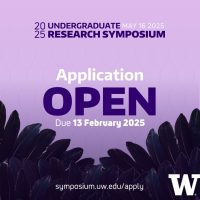
Applications are now open for the 2025 Undergraduate Research Symposium at the University of Washington. Open to undergrad researchers wanting to share and celebrate their research and creative works! Apply with a project title and statement, collaborate with your mentors and group members to see yourself on May 16, 2025.
Read more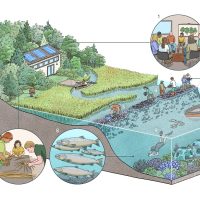
Ecosystem restoration has historically had a very ecological focus. However, while teaching a special interdisciplinary class during her time at Duke University, SAFS Assistant Professor, Carter Smith, took a slightly different view: how can ecosystem restoration be used to directly improve human wellbeing?
Read more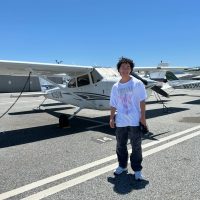
When awarded the NOAA Hollings Scholarship, students spend a summer working on a topic related to the wide-ranging scientific expertise of NOAA, from fisheries to the atmosphere. For SAFS undergrad, Michael Han, he’ll be joining the NOAA Hurricane Hunters to take data from notable past missions and present them in a visualized format on NOAA’s Science on a Sphere display.
Read moreThe King County Department of Natural Resources, Water and Land Resources Division seeks a seasonal Environmental Aide to assist with environmental monitoring and applied studies that support salmon recovery efforts. This position is in the Watershed and Ecological Assessment Team within the Science and Technical Support Section. The position will primarily support an experimental study of juvenile salmon growth and diet, along with a study of juvenile salmon use of tributary streams.
Read more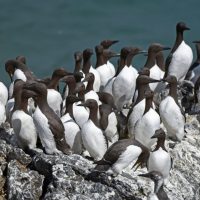
A University of Washington citizen science program — which trains coastal residents to search local beaches and document dead birds — has contributed to a new study, led by federal scientists, documenting the devastating effect of warming waters on common murres in Alaska.
Read more
Mark Scheuerell, SAFS Professor, has been named as an ASLO 2024 Sustaining Fellow, part of a cohort recognized for their sustained excellence in their contributions to ASLO and the aquatic sciences. ASLO is the Association for the Sciences of Limnology and Oceanography.
Read more
Working with specimens from the Burke Museum and NOAA, Elizabeth Miller, a former postdoc at SAFS, was captivated by the great diversity of shapes of anglers, which was at odds with how the species is often depicted in popular culture (think Finding Nemo). Elizabeth set out to build a family tree of anglerfishes and delve into the evolution of new shapes, such as body elongation.
Read more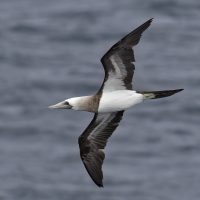
Across the globe, species are shifting their ranges in response to environmental changes driven by climate change. However, seabirds face distinct challenges in adapting to these shifts. Amelia DuVall, PhD candidate at SAFS and member of the Washington Cooperative Fish and Wildlife Research Unit, recently published a paper reporting on the breeding range expansion of two pantropical seabird species—the Brown Booby and the Blue-footed Booby.
Read more
During this year’s SAFS-NOAA Marine Mammal Laboratory internship program, two UW students split their time working on two Alaska pinniped projects: remote camera imagery and food habits.
Read more
50 years on from the Boldt Decision, SAFS held a one-day Bevan Symposium reflecting on Tribal fisheries, their co-management since this landmark decision, and what the next 50 years will look like for Washington fisheries. Centering on Tribal voices, the symposium heard from Tribal leaders, elders, scientists, artists and lawyers, through a series of panels and Q&A discussions.
Read more