Filter Results
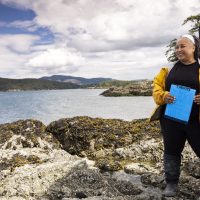
Interdisciplinary. Providing mentorship. Community-focused. These are just some of the terms that come to mind for Chris when she describes what it means to be a Black scientist. “When we think about being a non-majority community in STEM – and in this instance Black in STEM – we are tasked with a three-pronged responsibility because this is a lived experience for so many of us: being inherently interdisciplinary, mentor others, focus on your community”. Chris Mantegna is currently a graduate student at SAFS, after earning her bachelor’s degree in UW Marine Biology in 2021.
Read more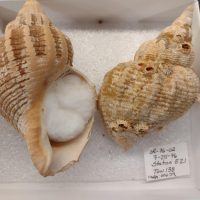
Walk along any beach, and you’re likely to find snail shells dotting the sand. In the Bering Sea, more than 200 species of sea snails exist. They’re an important source of prey for fish and walruses, playing a vital part in the Bering Sea food web. Working with a 50-year-old shell collection sourced from NOAA trawls from the mid-late 1970s, Jasper Nevis is looking at community structure in Bering Sea snails in collaboration with the Burke Museum Malacology Collection.
Read more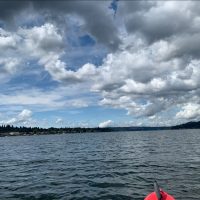
You may think aquatic and fishery science is all about fish, whales and oceans, but Iris Haley’s research is demonstrating that essentially anything to do with water is related to this field of study. What is Iris, a SAFS undergrad, investigating? The link between lake visitation and its relationship with heatwaves using cellphone data!
Read more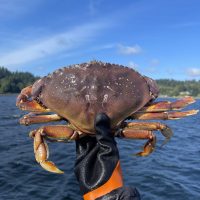
A collaborative network of agency and tribal scientists and resource managers, university faculty and students, and community volunteers are diligently working together to unlock the secrets of the Dungeness crab’s life cycle in the Salish Sea. The Pacific Northwest Crab Research Group (PCRG) is leading this unprecedented effort, generating vital data and fostering robust relationships to ensure the long-term sustainability of this ecologically, economically and culturally-important species.
Read more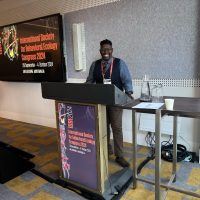
Ashley Townes writes about her experience presenting her doctoral research at the International Society for Behavioral Ecology (ISBE) Congress in Melbourne, Australia in the fall of 2024, describing it as an incredibly profound experience. Engaging with fellow researchers and ecologists from around the globe, all passionate and committed to the field of behavioral ecology enriched her perspective and deepened her own commitment to her research.
Read more
Dash Dicksion, a SAFS undergrad, got to return to his home island of Oahu during his NOAA HPP internship in the summer of 2024, working with the Ecosystem Sciences Division of NOAA’s Pacific Islands Fisheries Science Center. He spent 30 days at sea, plus time in the lab, focused on the biocultural and ecological aspects of fish larvae across Hawai’i Pae ‘Aina (the Hawaiian archipelago).
Read more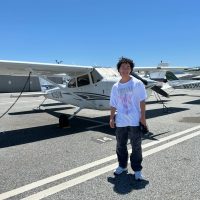
When awarded the NOAA Hollings Scholarship, students spend a summer working on a topic related to the wide-ranging scientific expertise of NOAA, from fisheries to the atmosphere. For SAFS undergrad, Michael Han, he’ll be joining the NOAA Hurricane Hunters to take data from notable past missions and present them in a visualized format on NOAA’s Science on a Sphere display.
Read more
Working with specimens from the Burke Museum and NOAA, Elizabeth Miller, a former postdoc at SAFS, was captivated by the great diversity of shapes of anglers, which was at odds with how the species is often depicted in popular culture (think Finding Nemo). Elizabeth set out to build a family tree of anglerfishes and delve into the evolution of new shapes, such as body elongation.
Read more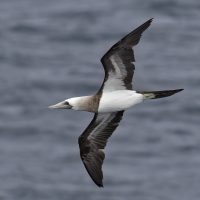
Across the globe, species are shifting their ranges in response to environmental changes driven by climate change. However, seabirds face distinct challenges in adapting to these shifts. Amelia DuVall, PhD candidate at SAFS and member of the Washington Cooperative Fish and Wildlife Research Unit, recently published a paper reporting on the breeding range expansion of two pantropical seabird species—the Brown Booby and the Blue-footed Booby.
Read more
During this year’s SAFS-NOAA Marine Mammal Laboratory internship program, two UW students split their time working on two Alaska pinniped projects: remote camera imagery and food habits.
Read more