Filter Results
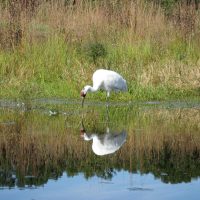
Whooping Cranes are highly endangered. To improve their recovery chances, a new migratory population was reintroduced into the wild in 2001, but their hatching success has been very low. A new study examines three possible hypotheses for this failure: harassment by black flies of nesting birds, effects of captive rearing, and inexperience of breeding birds. The overwhelming finding was that black fly harassment is the cause of poor hatching success: for example, when black fly numbers were reduced experimentally, breeding success doubled.
Read more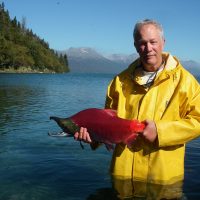
The updated version, contains brand new photos and information about the life cycles of these marvelous fish in freshwater and marine environments.
Read moreDams and river crossings often block the migration routes of stream-dwelling fish in addition to their better-known effects preventing salmon from spawning in upper river reaches. Relatively little is known about the movements of mountain whitefish (Prosopium williamsoni) in the Pacific Northwest, despite their widespread distribution. In the upper Cedar River, Washington, mountain whitefish had been absent above the Landsburg Dam, constructed in 1901, until a fish ladder was built in 2004 that allowed their upstream passage.
Read moreWhooping cranes are endangered and slowly recovering from a low point of just 15 birds and one migratory population in the wild. New efforts have established an eastern second migratory population from captive-bred birds, although not without some difficulty, since migration routes are learned from other adults. In the eastern population two methods were used to teach a new migration pathway: imprinting cranes on ultralight aircraft on the ground, which would lead the cranes to an overwintering destination; or imprinting them to follow older whooping cranes or wild sandhill cranes when they migrate.
Read moreSmallmouth bass are native to much of the midwestern USA and central Canada, but have been introduced to 41 states and 20 countries. While they are sought-after angling targets, they also are voracious predators of small fish and crayfish, which is of particular concern given their taste for baby salmon and trout. Thus it is crucially important for management and conservation to detect which streams have been occupied by smallmouth bass.
Read moreMany fish species repeatedly migrate from feeding areas to spawning areas, and their migration pathways could be innate or learned. Two possible models are examined for learning of these migration pathways: the Diffusion Model holds that fish head to spawning site near where they themselves hatched; while the Go With the Old Fish Model involves young fish joining schools of older fish, and learning migration pathways from the older fish.
Read moreCitizen science is when members of the public directly work with scientists on a particular question or issue. Participation can range from a large number of single interactions to repeated and complex sampling that requires substantial training. A new paper now explains how to train participants, validate the collected data, and produce rigorous scientific papers from the outcomes. Key highlights include the need to increase the quality of data when designing a project, and to apply quality control afterwards to check for issues with the collected data.
Read moreAfter a BS degree in Biology from Florida International University in 1979, I went to work for my father for six months while thinking about graduate school. UW came to my attention because it was rated in the top three aquaculture schools in the USA. I was pretty sure I wanted to be a marine biologist and thought aquaculture was the “way of the future”.
Read more
In 1980, I became the second woman to earn a PhD in fisheries at the UW. My program focused on water pollution ecology, emphasizing impacts of toxic chemicals on aquatic biota. I want to thank my dissertation committee, especially the late Dr. George Brown, who was the chair and a wonderful mentor, and Dr. Frieda Taub, who was also a wonderful mentor and an inspirational role model.
Read more
As the School approaches its centennial year (2019), we have been telling the stories of many of the important figures in SAFS’s development and evolution: deans, directors, faculty, and students. In fact, there have been many long-standing staff members who have played significant roles in helping SAFS become a major academic and research institution. Tom Oswold Jr. is one such long-term staff member.
Read more