Filter Results
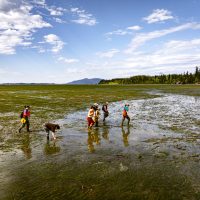
During low tide at Padilla Bay on a bright day in early May, you could find a class of UW undergraduates exploring the largest contiguous seagrass ecosystem in the lower 48. Why? To collect data to assess the habitat value of seagrass.
Read moreTulalip Tribes is hiring a full time temporary Wetland/Ecological Restoration Technician to work as an assistant to the Wetland Program Coordinator. The Wetland Technician will conduct field work in vegetation monitoring and management including developing skills in plant identification, invasive species control, maintaining stream and wetland restoration projects, data collection and management, and use of field data collection equipment including GPS.
Read more
Congratulations to the four recipients of the SAFS Faculty Merit Award, awarded to outstanding scholars and members of the SAFS community: Emma Meyer (BS), Liz Allyn (MS), Amelia DuVall (PhD), and Kristin Privitera-Johnson (PhD).
Read more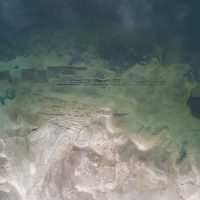
Shellfish aquaculture is a vital industry in the US, but one which faces mounting challenges threatening both productivity and business viability. Research often fails to align with growers’ immediate needs, so to close this gap, a team led by Connor Lewis-Smith set out to document how industry participants perceive ocean acidification threats and evaluate emerging adaptation strategies that are actively being researched.
Read moreAre you interested in advancing your academic and research experience in marine ecophysiology and environmental chemistry while immersing yourself in Italian culture? The University of Washington and the University of Milano-Bicocca (UNIMIB) are excited to announce a fellowship opportunity through the Erasmus+ KA171 program. Apply by May 26th, 2025.
Read moreCoursework, capstone, and connections: The multi-dimensional nature of the SAFS undergraduate degree
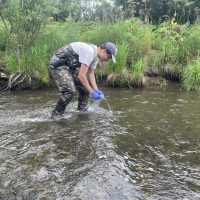
For many students about to embark on their undergraduate journey at university, they plan to study one thing but end up studying something completely different. This was the case for SAFS undergraduate, Ryan Luvera. Ryan is currently undertaking his capstone research project, focusing on improving salmon abundance estimation models using eDNA.
Read moreBig Water Consulting is pleased to offer a unique opportunity for an internship with a private, but public interest-oriented, consulting firm working on dynamic and evolving projects directly focused on enhancing the ability of tribal governments, housing authorities, and service providers use data to plan for the future and improve the communities they work for and in. One such project, the Northern Cheyenne Health and Housing Needs Assessment, is helping a tribe in rural Montana exercise its tribal data sovereignty by facilitating the tribe’s collection of data that accurately describes community conditions and preparation of reporting materials that will properly tell the community’s story and enable tribal leaders and program staff to plan for the future and attract the funding that their community needs.
Read more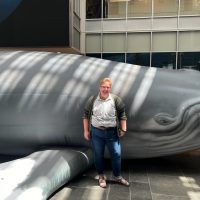
Zoe Rand is a recipient of this year’s College of the Environment Graduate Dean’s Medalist award, a PhD student in the Quantitative Ecology & Resource Management (QERM) Program and member of SAFS Professor Trevor Branch’s lab, using mathematical and statistical models to study the population dynamics of baleen whales.
Read moreAre you interested in applying to the NSF GRFP this fall? This five-year fellowship funds three years of your graduate education. Both undergraduate and graduate students can apply.
We are hosting an information session on the NSF GRFP to explain what it is, who is eligible for it, and a new structure for the workshop. We will also discuss the results of the most recent GRFP competition, and implications for future applicants.
Funded by the California Ocean Protection Council, SAFS Professor, Corey Garza, and colleagues at Stanford, UC Santa Cruz and the Middlebury Institute have embarked on a project to better understand shark and pinniped behavior off the California coast. They do this by tagging and tracking the animals, collecting background environmental data through buoys and mapping where pinnipeds gather. The goal is to understand how these variables interact and better predict when and where white sharks might be on the prowl — and, importantly, how to keep people out of the water when they are.
Read more