Filter Results
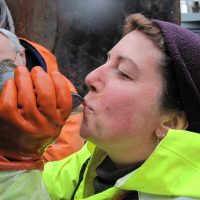
The story about how I arrived at SAFS takes some twists and turns, but all of them were interesting and eventually led me to the University of Washington and SAFS before I started working at the Alaska Fisheries Science Center (AFSC).
I grew up in landlocked southern Germany in a very small town. I spent much of my childhood at a local farmers’ stable and in the neighboring woods, and I knew from an early age that I wanted to be a biologist.
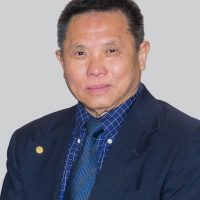
I started as a freshman at the College of Fisheries in the fall of 1968. I was very fortunate to have been awarded a Malaysian Government scholarship to study Fisheries in the United States when I graduated from High School in Malaysia. The scholarship was the blessing that molded my life. I knew I had to succeed. So I studied. I fast-tracked myself to earn three degrees at the University of Washington and managed to graduate summa cum laude in 1970.
Read more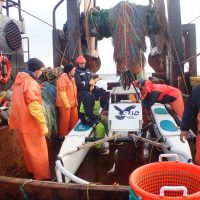
I grew up in Poland far away from the ocean. I remember my mom often bringing home pollock fillets for dinner. During that time (early 1980s), pollock was often the only fish we could get in the store. Later, during my studies on biological oceanography at the University of Gdansk (UG), I found out that pollock in Polish stores came mostly from the Bering Sea.
Read more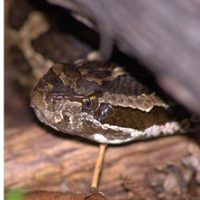
The U.S. Endangered Species Act has saved or recovered many species, and is recognized as one of the most powerful laws in the world for protecting the environment. The primary aim of the Act is to ensure that populations and species persist, and to conserve genetic variation in population. But little attention is paid to the adaptive potential of populations—the capability of populations to evolve when faced with new selective pressures—even though new genetic methods of sequencing the entire DNA of organisms are now cheaper and easier than ever before.
Read moreTo protect and recover species, most countries have laws that mandate particular actions when species are classified as threatened or endangered. These classifications can have an enormous impact on industries that impinge on the species in question, for example the declaration of northern spotted owls as endangered led to large-scale shutdowns in logging on old-growth forests. This process of classifying a species as threatened, endangered, or neither constitutes a difficult decision, and difficult decisions can usefully be approached using the theory and tools of decision analysis.
Read more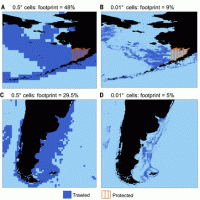
A new and more accurate study reveals that about 4% of the ocean area experiences fishing each year, a far smaller estimate than previous studies that relied on very large grid sizes. Two recent studies estimated that fishing takes place in 55% of the ocean and 90% of the ocean each year. But these estimates divide the ocean into 0.5°×0.5° grid cells, which are ~3100 km² in size at the equator, and assume each cell is fished if a single fishing location is recorded in the entire cell.
Read more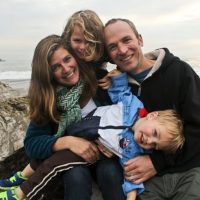
“Um, Bob, so…have you ever wanted to be a minister?” So went the request one sunny afternoon at the Volunteer Park wading pool, while we were sitting with Bob Francis (professor emeritus) as he watched his grandson. A few months later, Bob officiated our wedding, sprinkling the ceremony and our path forward with his salt-of-the-earth gruff charm. To say SAFS students ask a lot from their major professors was probably an understatement at that point.
Read more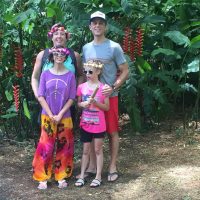
Jennifer and Mark came to SAFS by different routes.
Jennifer was born and raised in Bremerton, WA. She was fortunate to spend a lot of time sailing and SCUBA diving with her family and friends in Puget Sound. Much to her parents’ consternation, however, Jennifer spent her first year of college in Kenya, which offered her a rare opportunity to spend many months traveling around much of eastern and southern Africa.
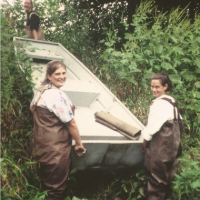
Melissa and Juan started their Aquatic and Fishery careers long before moving to Seattle from Ohio and Argentina, respectively, to add School and Sciences. They found much more than that at SAFS.
Melissa grew up on the shores of Lake Erie, doing undergraduate fieldwork on endangered freshwater mussels, subsequently completing her MS at The Ohio State University (OSU). At OSU, she sat in the Byrd Polar Research Center, where climate and climate change were the principal research topics that seized her interest.
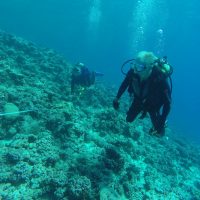
All in the (marine science) family
The Buckley/Gómez-Buckley family has a “score card” at SAFS that reads, BS – 2, MS – 3, PhD -1, with 1 PhD on the horizon. Ours is truly a family with adventures in marine science that over the years have ranged from the Arctic Ocean south to the Coral Sea, and from the Philippine Sea east to the Indian Ocean.