Filter Results
Australian lungfish are living fossils that have survived virtually unchanged since their appearance in the fossil record 340 million years ago. They are well known to have the nifty ability to survive for several days out of water. Now, a new study uses their scales to infer what they ate over periods of more than 50 years. The new technique first ages the lungfish by measuring radioactive signatures in the scales that track radioactivity from nuclear weapons testing in the 1950s and 1960s, and then having dated micro-slices of the fish scales, each slice is examined for carbon and nitrogen isotopes that unveil their food sources throughout their life.
Read more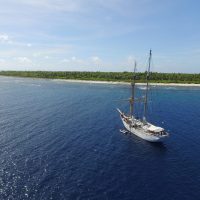
Andrew Chin, a senior double majoring in Aquatic and Fishery Sciences and Marine Biology shares his month-long experience sailing South Pacific with the SEA Semester program
Read more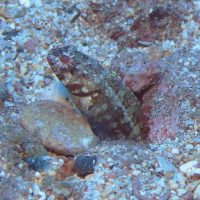
Two new species of jawfishes (family Opistognathidae) have been described for the first time this month. These small fish have fascinating life histories, digging burrows in sandy bottoms near reefs, and relying on males to brood eggs in their mouths. Each burrow houses one fish, and they strongly defend their burrows. The first new species, Thionyi’s jawfish (Opistognathus thionyi), is found in Vitória-Trindade Chain and Fernando de Noronha Archipelago off Brazil; while the second new species, the Brazilian dusky jawfish (Opistognathus vicinus), is found off mainland Brazil.
Read more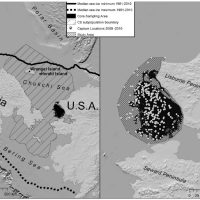
Polar bears, like other large predators, are hard to track and count, and available data is often fragmentary and difficult to piece together. Now, a new model provides estimates for key parameters for polar bears in the Chukchi Sea off north-western Alaska, by combining available data from telemetry, marking and recapturing, and counts. The model estimates that 83% of females give birth every year, that litter sizes are 2.11 per year, and that survival is about 90% for both males and females.
Read moreIndividual fishing quotas have been introduced to the Pacific whiting fishery off the US west coast, involving allocating rights to fish quota to both harvesters (80%) and processors (20%) and letting individuals decide when and how to to catch and land fish. A unique dataset of prices and costs allowed researchers to examine the impact of this change on land-based processors.
Read more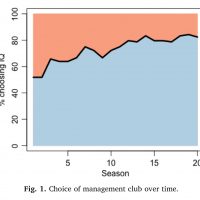
Many natural resources, such as grazing lands, forests, and fisheries, can be managed either by lots of people communally (common property), by top-down regulation, or by individual rights. A new analysis shows experimentally that individual rights emerge as the preferred choice when people are given freedom to choose among different clubs that each decide how to manage part of the resource.
Read more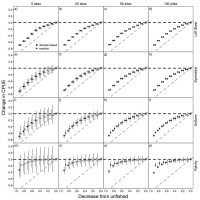
Scientific surveys using fishing rods, each fishing multiple hooks, have the advantage of being able to access rocky areas while obtaining samples of fish for length and age estimation. However, in areas with lots of fish, it is possible for nearly every hook to catch a fish, resulting in an upper limit on the number of fish that can be counted.
Read moreNew and weird species are being discovered all the time, and the latest is the Narungga Frogfish (Histiophryne narungga), which has just been described. The name honors the Narungga tribe of indigenous Australians who traditionally inhabited the lands in which it was found. The new species comes in a variety of dotted forms, occurs in southern and western Australia, and is a member of the order Lophiiformes.
Read more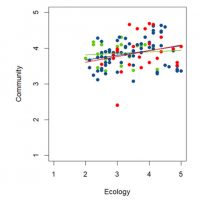
Fisheries management is often seen as a balancing act that aims for economic development, environmental protection and social development. Previous work shows that overfishing or other forms of poor ecological health, reduces economic profits; and it has long been assumed that pursuit of profits leads to poor social outcomes for fishing communities. But now a new analysis of 121 fisheries worldwide suggests this second assumption may not hold, based on scores of 68 different ecological, economic, and social metrics for each fishery.
Read more
“Having recently moved, we sometimes find ourselves asking ‘how did we end up living in Madrid?’ The answer lies in part in our professional and personal experiences gained at SAFS.”
“While at SAFS, I studied salmon hatchery/wild interactions and growth through the lens of quantitative genetics with Kerry Naish”, says Erin. “I was also a teaching assistant for the Conservation Genetics class for several years, which had a considerable impact on my continued interest in science education.”
Nathan was at SAFS as a post-doctoral fellow from 2006 to 2008.